Why Is My Dog Walking in Circles? Possible Causes and Warning Signs
A dog walking in circles may be doing something completely normal, especially before lying down, going to the bathroom, or settling into a comfortable position.
But repeated or unusual circling can have a very different meaning.
If your dog suddenly starts walking in circles, repeatedly circles in the same direction, appears confused, loses balance, develops a head tilt, or shows other unusual symptoms, the behavior may be associated with an underlying medical problem.
Circling is not a diagnosis by itself. Veterinarians consider the dog’s age, when the behavior started, whether it happens occasionally or continuously, which direction the dog circles, and what other symptoms are present.
If you notice other changes along with the circling, you can also check your dog’s symptoms to learn more about signs that may be occurring at the same time.
Is It Normal for a Dog to Walk in Circles?
Sometimes.
Dogs commonly turn around before lying down, sleeping, or finding a comfortable resting position. Some dogs also circle briefly before urinating or having a bowel movement.
This type of behavior is usually brief, purposeful, and followed by another normal activity.
Repeated circling without an obvious reason is different.
The behavior deserves closer attention when a dog walks in circles for extended periods, repeatedly turns toward the same side, appears disoriented, bumps into objects, has difficulty balancing, or suddenly develops the behavior when it was not present before.
According to the Merck Veterinary Manual, circling can be one of the abnormalities veterinarians evaluate during a neurological examination, particularly when it occurs with changes in gait, coordination, posture, or behavior.
Why Is My Dog Walking in Circles?
There is no single explanation for circling.
Possible causes range from normal behavioral routines to problems affecting balance, the inner ear, vision, cognition, or the nervous system.
The pattern of circling can provide useful information.
A dog that briefly circles before lying down is displaying a very different pattern from a dog that suddenly begins circling continuously while appearing disoriented.
This is why the behavior should always be considered together with other symptoms.
Common Causes of a Dog Walking in Circles
Several conditions and situations can contribute to circling behavior.
1. Normal Behavioral Circling
Not every circle is a warning sign.
Dogs may naturally turn several times before lying down, sleeping, or choosing a comfortable position.
They may also circle while investigating smells or preparing to eliminate outdoors.
When the behavior is brief and your dog immediately returns to normal activity, it is generally less concerning than persistent or unexplained circling.
2. Vestibular Problems
The vestibular system helps dogs maintain balance, orientation, and normal movement.
When this system is affected, dogs may suddenly become unsteady or disoriented.
VCA explains that signs of vestibular disease in dogs can include sudden loss of balance, disorientation, falling or circling toward one side, head tilt, abnormal eye movements, and reluctance to stand or walk.
A dog with vestibular problems may appear as though the environment is moving around him.
This can make standing and walking difficult and may also lead to nausea or reduced appetite.
If your dog is also holding his head consistently toward one side, read why your dog may be tilting his head.
3. Middle or Inner Ear Problems
The inner ear contains structures that play an important role in balance.
Problems affecting this area can cause changes in the way a dog walks and holds his head.
The Merck Veterinary Manual reports that inner-ear inflammation can cause head tilt, loss of coordination, leaning or falling toward one side, and tight circling toward the affected side.
VCA similarly notes that an inner ear infection may affect balance and cause a dog to walk in circles toward the affected ear.
Other ear-related symptoms may include head shaking, ear discomfort, or a persistent head tilt.
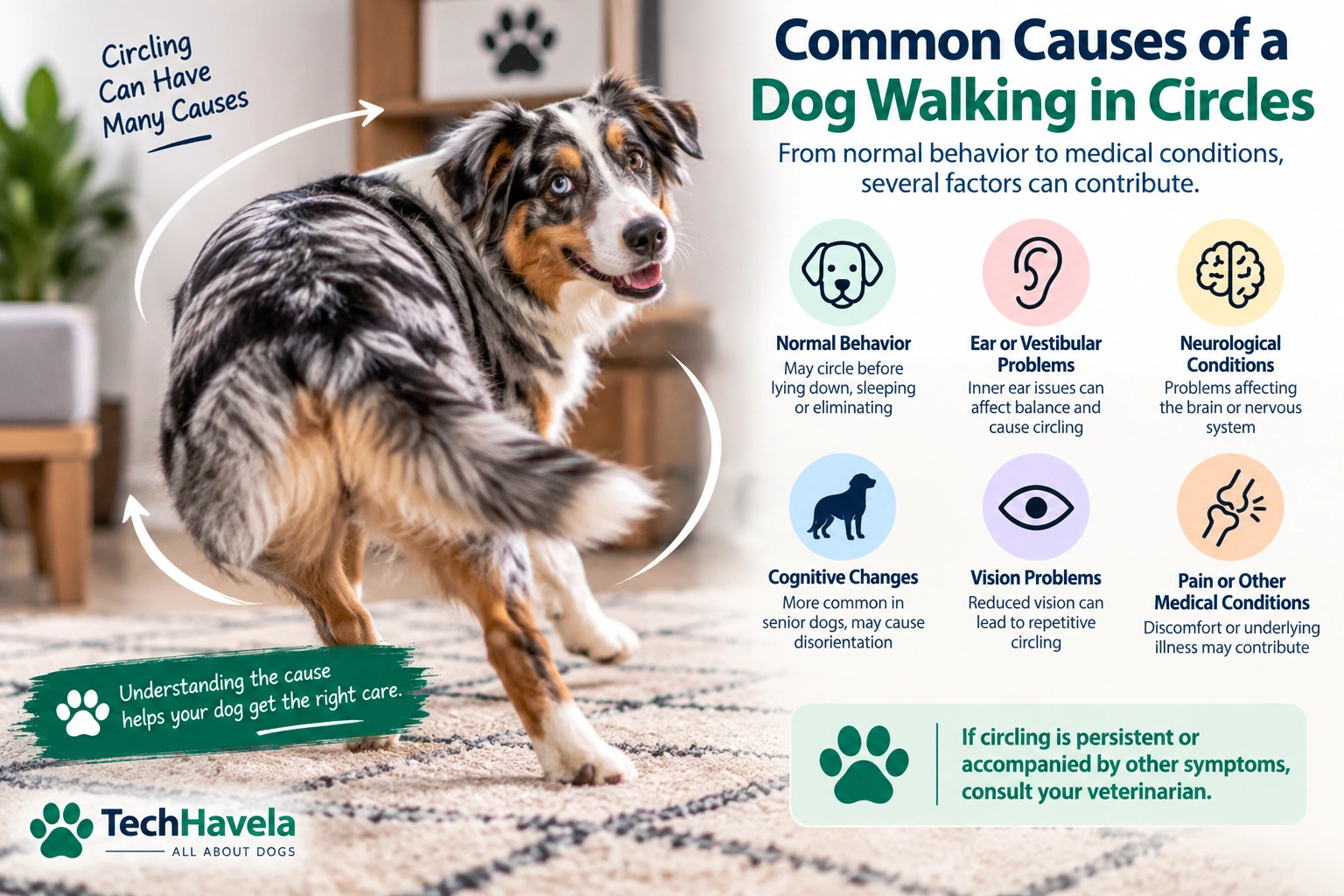
4. Cognitive Changes in Senior Dogs
Circling can sometimes occur in older dogs experiencing age-related cognitive changes.
Canine cognitive dysfunction syndrome affects behavior, memory, awareness, and interaction with the environment.
According to Cornell University College of Veterinary Medicine, signs can include disorientation, getting lost in familiar places, becoming stuck in corners, altered sleep patterns, restlessness, pacing, changes in interaction, and loss of previously learned behaviors.
However, circling in an older dog should not automatically be assumed to be cognitive decline.
Other medical conditions can produce similar behavioral changes, which is why veterinary examination is important when a senior dog’s behavior changes noticeably.
5. Neurological Problems
Persistent circling can sometimes be associated with problems affecting the brain or nervous system.
Merck notes that neurological evaluation includes observing how a dog walks, turns, coordinates movement, and responds to the environment. Circling in one direction can occur with certain abnormalities involving the brain.
Neurological problems may produce other signs as well, including changes in awareness, unusual behavior, weakness, abnormal coordination, or seizures.
Circling alone cannot identify which neurological condition, if any, is present.
A veterinary neurological examination is needed to determine whether the nervous system may be involved.
6. Vision Problems
Dogs with reduced vision may move differently as they try to navigate their surroundings.
They may hesitate, bump into objects, become reluctant to use stairs, or appear confused in unfamiliar environments.
A dog that cannot clearly see obstacles may also develop repetitive movement patterns.
Because vision loss, cognitive changes, balance disorders, and neurological conditions can sometimes produce similar outward behavior, new circling should not be diagnosed based on observation alone.
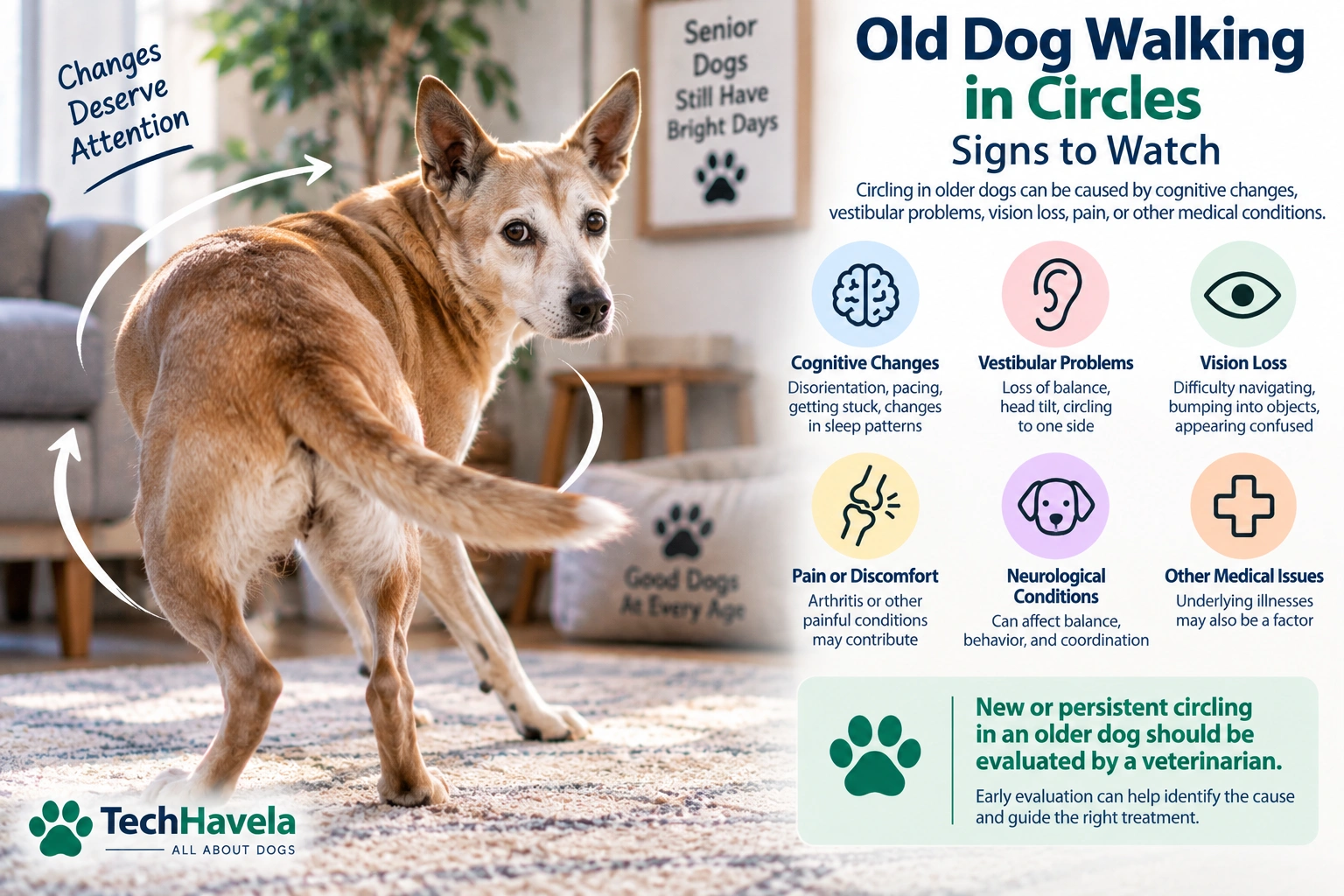
Old Dog Walking in Circles
An old dog walking in circles deserves particular attention because several age-related conditions can produce similar behavior.
Some senior dogs develop cognitive dysfunction and may become disoriented, pace around the house, get stuck in corners, or have changes in their sleep-wake cycle.
Veterinary Cornell notes that canine cognitive dysfunction is an age-related condition and that dogs may begin developing signs around nine years of age or older.
But cognitive dysfunction is not the only possibility.
Older dogs can also develop vestibular problems, vision changes, pain, systemic illnesses, or neurological disorders.
Sudden circling in a senior dog should therefore not simply be dismissed as normal aging.
Why Is My Dog Walking in Circles Around the House?
Circling around the house can have several meanings depending on the circumstances.
A dog may simply be looking for a comfortable place to rest or following a familiar routine.
Persistent wandering or circling without an obvious goal is different.
Watch whether your dog seems to know where he is going.
Disorientation may appear as staring into space, becoming trapped behind furniture, repeatedly entering the same area, standing on the wrong side of a door, or wandering during the night.
In senior dogs, these behavioral changes can occur with cognitive dysfunction, but other medical causes should also be considered.
Dog Walking in Circles and Head Tilt
Circling combined with a persistent head tilt is more concerning than either an occasional circle or a brief curious head tilt.
The combination can occur with vestibular disorders and conditions affecting the inner ear.
A dog may lean, stumble, fall, or circle toward one side.
Abnormal eye movements may also occur.
The vestibular system plays an important role in balance, and disruption can make a dog appear severely disoriented even when the dog remains mentally alert.
Persistent head tilt combined with balance problems or circling warrants veterinary attention.
Dog Walking in Circles and Falling Over
A dog that is circling and falling, stumbling, or unable to maintain balance should be evaluated promptly.
These signs may indicate a problem affecting the vestibular system, nervous system, or another structure involved in coordination.
Vca describes unsteadiness, falling, head tilt, abnormal eye movements, and circling as possible signs associated with vestibular disease.
If your dog is having difficulty walking normally, our guide to why a dog may be limping can help distinguish some common limb-related problems from signs involving balance or coordination.
Dog Walking in Circles and Panting
Panting can occur for many reasons, including heat, physical activity, excitement, stress, pain, or illness.
When panting appears together with persistent circling, the overall situation matters.
A dog that is pacing, circling, panting, and unable to settle may be experiencing discomfort, anxiety, disorientation, or another medical problem.
Look for additional symptoms such as weakness, vomiting, loss of balance, head tilt, unusual behavior, or difficulty breathing.
If breathing itself appears abnormal or unusually rapid, read why your dog may be breathing fast.
Dog Walking in Circles After a Seizure
Some dogs may show temporary behavioral or neurological changes after a seizure.
Confusion, restlessness, unusual movement, or altered awareness may occur during the recovery period.
However, circling can also be associated with neurological abnormalities independent of seizures. Merck Veterinary Manual notes that seizures, behavioral changes, constant pacing, and circling can be among signs considered during neurological assessment. (l)
A first seizure, repeated seizures, prolonged abnormal behavior, or significant difficulty recovering warrants veterinary attention.
Why Does My Dog Keep Walking in the Same Direction?
Repeatedly circling toward the same side can provide useful information to a veterinarian.
Certain vestibular problems can cause a dog to lean, fall, or circle toward the affected side, while some neurological conditions involving the forebrain can also produce one-directional circling.
That does not mean the direction alone can identify the cause.
Observe whether the dog consistently circles left or right and whether head tilt, weakness, abnormal eye movements, disorientation, or balance problems occur at the same time.
A short video of the behavior can also be useful to show your veterinarian.
Dog Walking in Circles and Acting Confused
Circling accompanied by confusion deserves closer attention.
Signs of disorientation can include getting lost in familiar surroundings, staring into space, becoming stuck in corners, failing to recognize familiar routines, or wandering without an obvious purpose.
In older dogs, these signs may be associated with cognitive dysfunction.
However, sudden confusion can also occur with neurological or vestibular problems.
The speed at which the behavior develops is therefore important.
A gradual behavioral change over months presents differently from sudden severe disorientation that appears within minutes or hours.
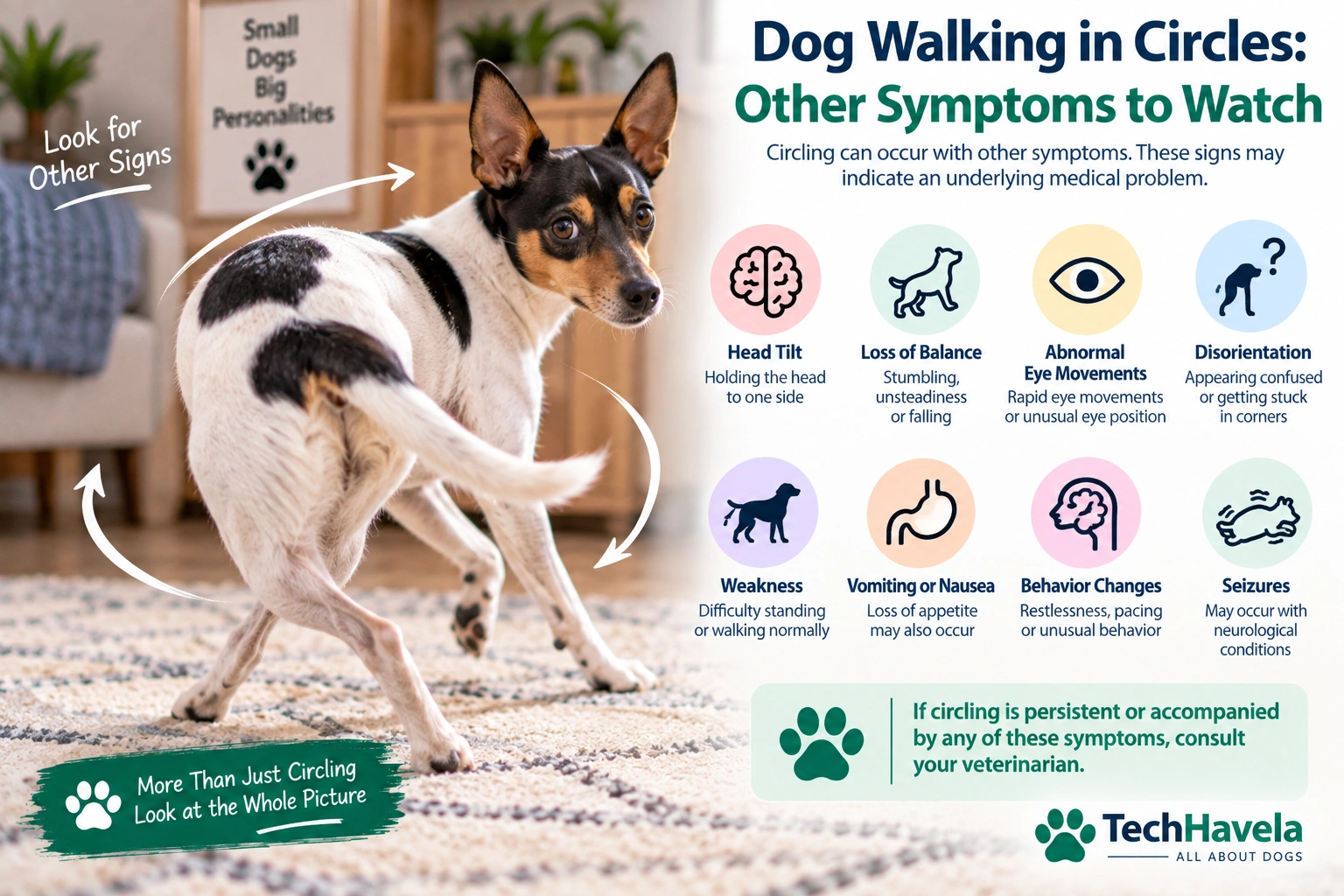
Is a Dog Walking in Circles an Emergency?
Not every episode of circling is an emergency.
Brief circling before lying down or going to the bathroom can be normal.
Sudden, persistent circling accompanied by neurological or balance-related changes is different.
Seek prompt veterinary care if circling occurs with significant loss of balance, repeated falling, inability to stand normally, persistent head tilt, abnormal rapid eye movements, marked weakness, seizures, collapse, or a major change in awareness or behavior.
Vca notes that vestibular signs can develop suddenly and may include disorientation, loss of coordination, falling, circling, head tilt, and involuntary eye movements.
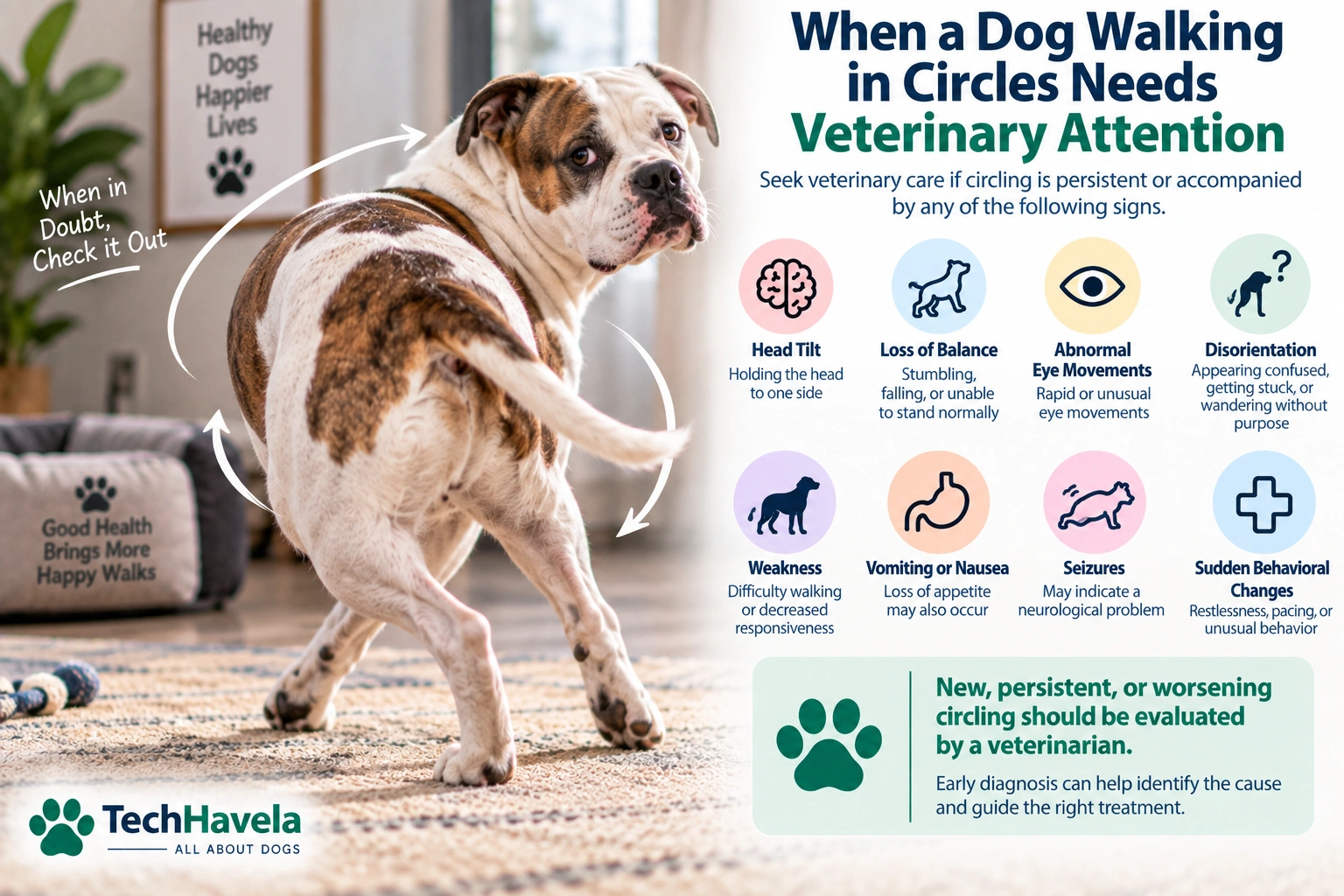
When Should I Take My Dog to the Veterinarian?
Veterinary evaluation is appropriate when circling is new, persistent, worsening, or clearly different from your dog’s normal behavior.
Pay particular attention when circling occurs together with:
- Head tilt
- Loss of balance
- Falling or stumbling
- Abnormal eye movements
- Weakness
- Disorientation
- Sudden behavioral changes
- Difficulty standing or walking
- Seizures
- Vomiting or nausea
- Significant changes in appetite
If your dog’s appetite has also changed, read why your dog may not be eating.
Sudden neurological or balance-related symptoms should not be assumed to be normal aging, even in an elderly dog.
What Will the Veterinarian Check?
The veterinarian will begin by asking about your dog’s history and examining the pattern of the circling.
Useful information includes when the behavior began, whether it developed suddenly or gradually, how frequently it happens, whether your dog always circles in the same direction, and what other symptoms occur.
A physical and neurological examination may evaluate gait, posture, reflexes, coordination, balance, eye movements, head position, and responses involving the cranial nerves.
The Merck Veterinary Manual explains that neurological evaluation may be followed by laboratory testing or advanced diagnostic procedures depending on the findings.
Blood tests and urinalysis may be used to look for underlying medical problems.
In some cases, additional tests such as imaging may be recommended when a neurological cause is suspected.
Should I Record My Dog Walking in Circles?
Yes.
If it can be done without interfering with your dog’s safety, a short video of the behavior can be useful during a veterinary appointment.
Circling may not happen while the dog is inside the clinic.
A video can show how quickly your dog moves, which direction he circles, whether he falls or stumbles, how the head is positioned, and whether unusual eye or body movements occur.
Also note approximately when the behavior started and how often it happens.
These observations can provide useful context for the veterinarian.
Can a Dog Recover From Circling?
Recovery depends entirely on the underlying cause.
Circling is a symptom rather than a disease.
Some causes may be temporary, while others require ongoing veterinary management.
For example, VCA reports that many dogs with idiopathic vestibular disease begin improving within several days, although recovery varies and some dogs can retain mild head tilt or unsteadiness.
Cognitive dysfunction, by contrast, is generally progressive and requires a different approach to management.
This is why identifying the underlying cause is much more important than treating circling as a condition by itself.
Frequently Asked Questions
Why is my dog walking in circles?
A dog may circle as part of normal behavior before resting or eliminating. Persistent or unexplained circling can also be associated with vestibular problems, inner-ear disease, cognitive changes, vision problems, or neurological conditions.
Why is my old dog walking in circles?
Senior dogs may circle because of cognitive dysfunction, but vestibular disorders, vision changes, neurological problems, pain, and other medical conditions can produce similar behavior. New or persistent circling should be discussed with a veterinarian.
Why does my dog walk in circles before lying down?
Brief circling before settling into a resting position is common canine behavior and is generally different from persistent, repetitive circling associated with disorientation or balance problems.
Why is my dog walking in circles around the house?
The meaning depends on the pattern. A dog may simply be looking for somewhere to settle. Repetitive wandering, getting stuck, appearing confused, or circling without an obvious purpose deserves closer attention.
Why is my dog walking in circles and losing balance?
Circling combined with loss of balance can occur with vestibular disorders and other neurological problems. Head tilt, falling, abnormal eye movements, or difficulty standing are additional signs that warrant prompt veterinary attention. (Vca)
Can an ear problem make a dog walk in circles?
Yes. Problems involving the inner ear can interfere with the vestibular system and may cause head tilt, imbalance, leaning, falling, or circling.
Can cognitive dysfunction make an old dog walk in circles?
Age-related cognitive dysfunction can cause disorientation, pacing, wandering, changes in sleep patterns, and other behavioral changes. However, other medical conditions can look similar, so circling should not automatically be attributed to aging.
Should I worry if my dog suddenly starts walking in circles?
Sudden persistent circling is more concerning than a familiar behavioral routine, especially when accompanied by head tilt, loss of balance, falling, abnormal eye movements, weakness, seizures, or significant disorientation.
Bottom Line
A dog walking in circles is not always experiencing a medical problem. Brief circling before lying down, sleeping, or eliminating can be normal behavior.
Persistent, repetitive, or sudden circling is different.
Vestibular disorders, middle or inner ear problems, cognitive changes in older dogs, vision problems, and neurological conditions are among the possible explanations.
Pay particular attention to circling accompanied by head tilt, falling, loss of balance, abnormal eye movements, weakness, seizures, or significant disorientation.
Because many different conditions can produce similar signs, the pattern of the behavior and the other symptoms occurring with it are important.
New, persistent, worsening, or unusual circling should be evaluated by a veterinarian.

**Sidnir Vieira**
Founder of TechHavela
A passionate pet and tech content creator, helping dog owners across the U.S. make smarter decisions for their furry friends.