Why Is My Dog Peeing So Much? Possible Causes to Watch
If you have noticed your dog asking to go outside more often, producing more urine, or suddenly having accidents indoors, you may be wondering, “Why is my dog peeing so much?”
Dogs can urinate more frequently for several reasons. Sometimes the explanation is simple, such as drinking more water, warm weather, increased activity, or a temporary change in routine.
However, frequent urination can also be associated with urinary tract problems, medications, diabetes, kidney disease, hormonal conditions, or other health issues.
The important thing is to look at what has changed from your dog’s normal routine.
Pay attention to how often your dog urinates, how much urine is produced, whether your dog is drinking more water, and whether there are changes in appetite, weight, energy, or behavior.
Why Is My Dog Peeing So Much?
Urination is one of the body’s natural ways of removing waste and maintaining fluid balance.
How often a dog urinates can vary depending on factors such as:
- Water intake
- Diet
- Age
- Activity
- Weather
- Medications
- Daily routine
- Overall health
For example, a dog that drinks more water may naturally need to urinate more frequently.
The pattern becomes more important when there is a noticeable change without an obvious explanation.
If your dog suddenly starts urinating much more often than usual, consider both frequency and volume.
A dog that urinates frequently in small amounts may be experiencing something different from a dog that produces unusually large amounts of urine.
That distinction can provide useful information for your veterinarian.
Is My Dog Peeing More Often or Producing More Urine?
These two situations may look similar, but they are not necessarily the same.
Frequent urination means your dog tries to urinate more often.
Increased urine volume means your dog produces a larger total amount of urine.
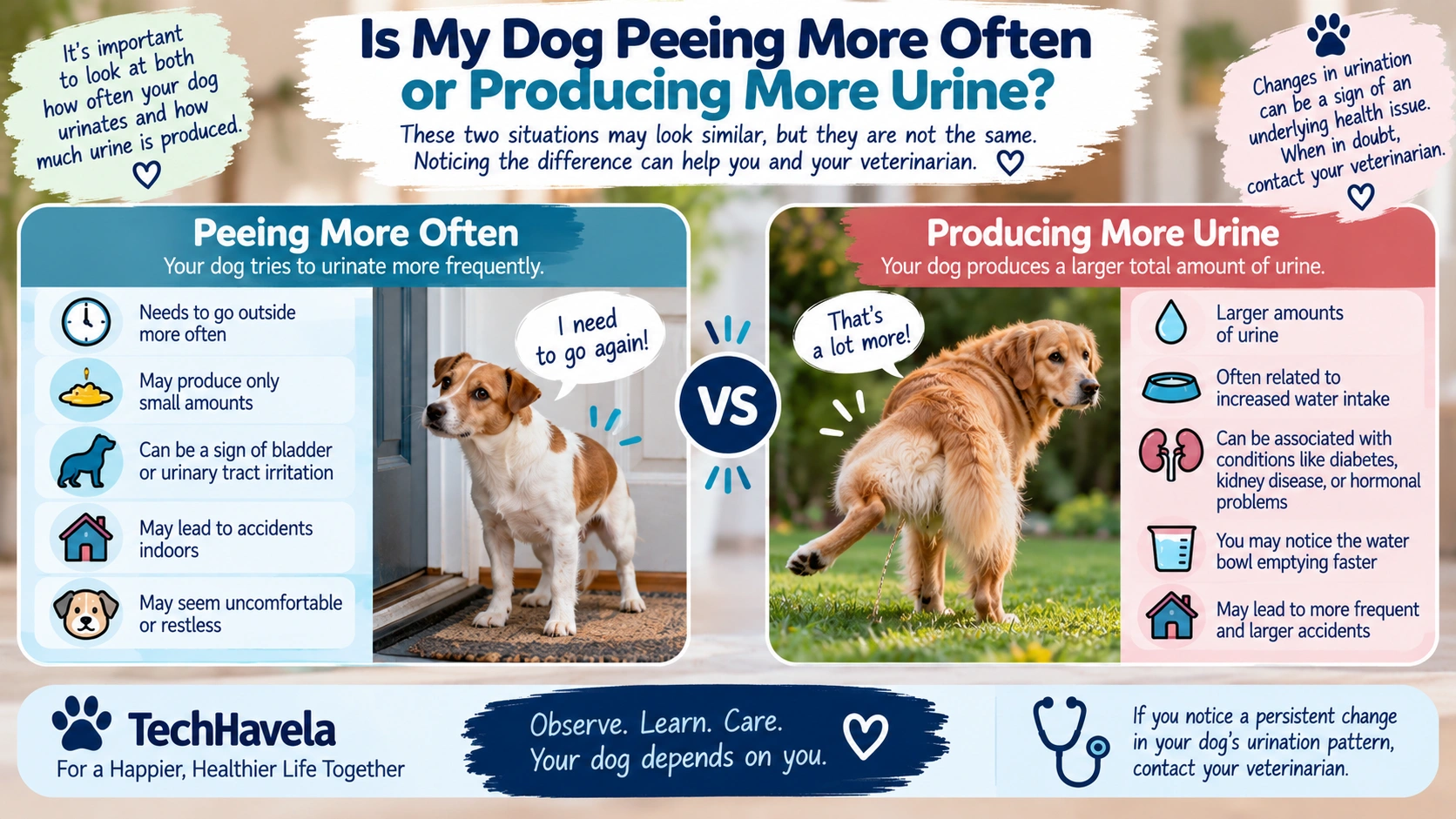
For example, a dog with irritation in the urinary tract may repeatedly ask to go outside but produce only small amounts.
Another dog may urinate large amounts because the body is producing more urine than usual.
Pay attention to:
- How often your dog asks to go outside
- Whether each urination produces a small or large amount
- Whether your dog appears uncomfortable
- Whether there are accidents indoors
- Whether water intake has increased
- Whether urine looks or smells different from usual
These details can help your veterinarian understand what may be happening.
7 Possible Reasons Your Dog Is Peeing More
1. Drinking More Water
One of the simplest explanations for increased urination is increased water intake.
If your dog drinks more, the body generally has more fluid to eliminate.
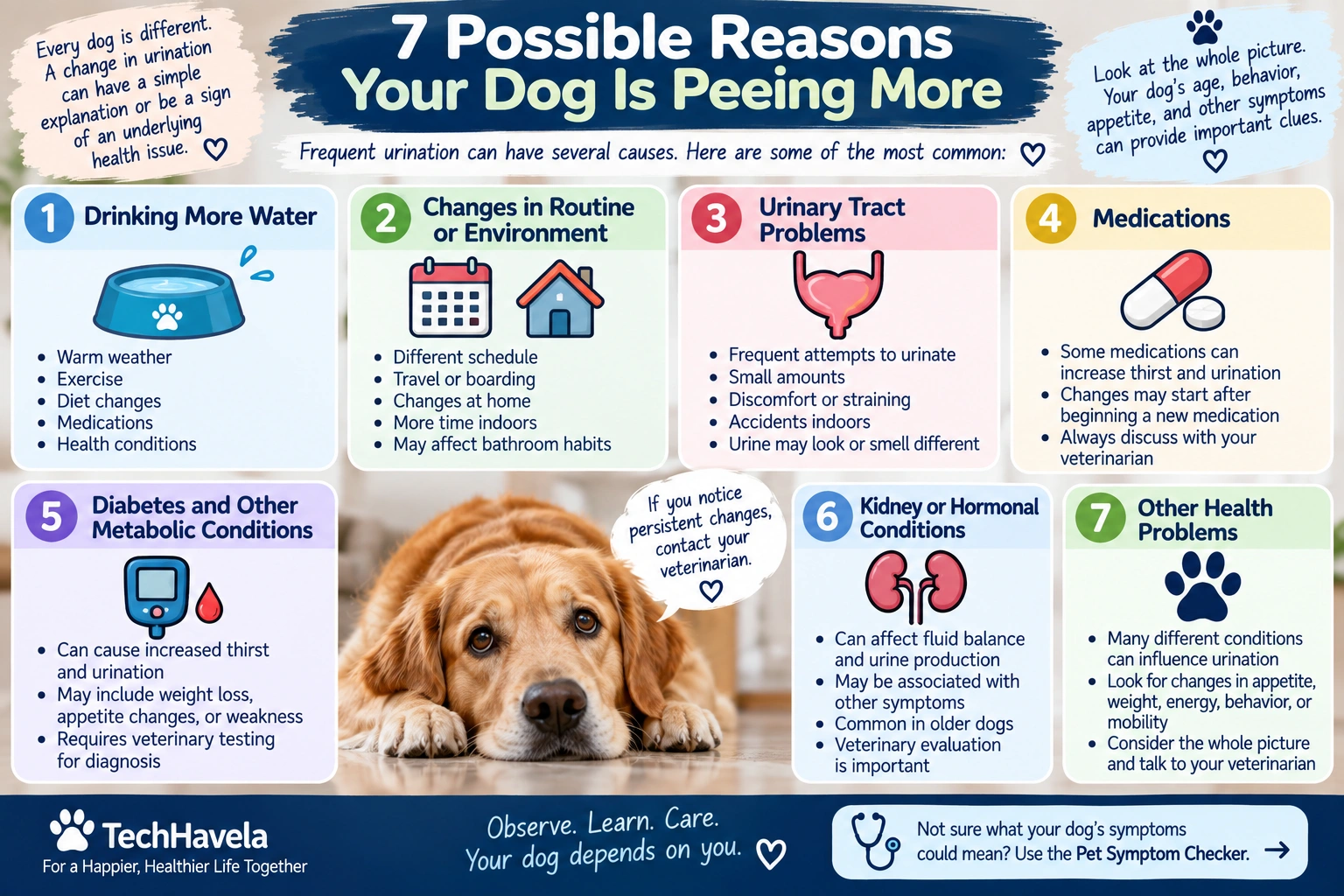
Dogs may drink more because of:
- Warm weather
- Exercise
- Diet changes
- Fluid loss
- Medications
- Health conditions
If both drinking and urination have increased significantly without an obvious explanation, the combination deserves attention.
Persistent increased thirst and urination can sometimes occur together with several medical conditions.
2. Changes in Routine or Environment
Changes in your dog’s schedule can influence bathroom habits.
A different walking schedule, longer periods indoors, travel, excitement, or changes around the home may affect when your dog urinates.
Puppies and older dogs may also have different bathroom needs than healthy adult dogs.
Consider whether anything in your dog’s daily routine changed around the same time the frequent urination began.
However, a major or persistent change should not automatically be blamed on routine, particularly when other symptoms are present.
3. Urinary Tract Problems
Problems affecting the bladder or urinary tract can cause dogs to attempt to urinate more frequently.
The Merck Veterinary Manual notes that signs of bladder infection can include frequent urination, painful or difficult urination, and urinating in inappropriate places.
Possible signs may include:
- Frequent attempts to urinate
- Passing only small amounts
- Accidents indoors
- Discomfort while urinating
- Licking around the urinary area
- Urine that appears unusual
- Changes in urine odor
Several different urinary conditions can produce similar symptoms, so the cause cannot be determined from these signs alone.
Veterinary examination and testing may be necessary.
4. Medications
Some medications can increase thirst, urination, or both.
If your dog’s bathroom habits changed after starting a medication, contact your veterinarian if you are concerned.
Do not stop, reduce, or change a prescribed medication without veterinary guidance.
It can be helpful to tell your veterinarian:
- The medication your dog is taking
- When treatment began
- When increased urination started
- Whether thirst also increased
- Whether any other symptoms appeared
This information may help determine whether the medication could be contributing to the change.
5. Diabetes and Other Metabolic Conditions
Certain metabolic conditions can affect how the body manages glucose, fluids, and urine.
Diabetes mellitus, for example, can be associated with increased thirst and increased urination.
Other changes may include:
- Weight loss
- Appetite changes
- Reduced energy
- Weakness
- Changes in behavior
These symptoms are not enough to diagnose diabetes or another metabolic condition.
Veterinary testing is needed to determine the cause.
6. Kidney or Hormonal Conditions
The kidneys play an important role in controlling fluid balance and producing urine.
Conditions affecting kidney function may change how much a dog drinks and urinates.
Certain hormonal disorders can also influence thirst and urine production.
Possible accompanying changes can include:
- Increased thirst
- Appetite changes
- Weight changes
- Weakness
- Reduced activity
- Changes in coat or skin
- Other behavior changes
Because many different conditions can produce similar signs, persistent increased urination should be evaluated in context rather than linked to one disease based on symptoms alone.
7. Other Health Problems
Frequent urination is a relatively nonspecific sign.
Other health problems can influence water intake, fluid balance, bladder function, or urine production.
This is why observing the whole picture is important.
Consider your dog’s:
- Drinking habits
- Appetite
- Weight
- Energy
- Mobility
- Digestive symptoms
- Medications
- Behavior
- Age
- Recent health changes
Your veterinarian can combine these observations with an examination and appropriate tests if needed.
Why Is My Dog Peeing So Much and Drinking So Much Water?
Increased thirst and increased urination commonly occur together.
According to VCA Animal Hospitals, increased thirst and urination can occur together for several reasons, and veterinary testing may be needed to identify the underlying cause.
When a dog drinks considerably more water, more fluid may eventually be eliminated through urine.
At the same time, certain medical conditions can cause changes in both thirst and urine production.
You may notice:
- The water bowl emptying more quickly
- More frequent trips outside
- Larger amounts of urine
- Waking during the night to drink or urinate
- Accidents indoors
- Changes in appetite
- Changes in weight or energy
If both drinking and urination remain noticeably increased, contact your veterinarian.
The combination can have several possible causes, and veterinary evaluation may be necessary to determine what is happening.
Why Is My Dog Peeing Frequently but Only a Little?
Frequent attempts to urinate with only small amounts coming out can be different from simply producing more urine.
This pattern may occur when the bladder or urinary tract is irritated.
Watch for signs such as:
- Repeated attempts to urinate
- Straining or obvious discomfort
- Very small amounts of urine
- Accidents indoors
- Licking around the urinary area
- Restlessness
- Urine that looks unusual
A dog repeatedly attempting to urinate but producing very little or no urine needs prompt veterinary attention.
Difficulty passing urine can be more concerning than simply needing to urinate more frequently.
Why Is My Dog Suddenly Peeing in the House?
Indoor accidents can be frustrating, especially when a previously house-trained dog suddenly begins having them.
But a sudden change should not automatically be treated as a behavior problem.
Possible explanations can include:
- Increased water intake
- Increased urine production
- Urinary tract discomfort
- Difficulty holding urine
- Changes in routine
- Mobility problems
- Age-related changes
- Stress or environmental changes
- Other health problems
Instead of focusing only on the accident itself, look for changes in drinking, frequency, urine volume, appetite, energy, mobility, or behavior.
Persistent new accidents deserve veterinary attention, particularly in a dog that was previously reliably house-trained.
Why Is My Dog Peeing More at Night?
A new need to urinate during the night may occur because your dog is producing more urine or drinking more water.
Consider whether your dog also:
- Drinks during the night
- Empties the water bowl faster
- Has difficulty settling
- Has accidents while sleeping
- Seems unusually restless
- Has appetite changes
- Is losing weight
- Appears weak or tired
Occasional nighttime urination may have a simple explanation.
A persistent new pattern, especially when accompanied by increased thirst or other symptoms, should be discussed with your veterinarian.
Why Is My Older Dog Peeing So Much?
Older dogs can experience changes that affect bathroom habits, but frequent urination should not automatically be dismissed as normal aging.
Senior dogs may develop health conditions that affect:
- Kidney function
- Hormone regulation
- Blood sugar
- Bladder control
- Mobility
- Water intake
Mobility problems may also make it harder for an older dog to reach the appropriate bathroom area in time.
If an older dog develops a noticeable new pattern of increased urination, veterinary evaluation can help identify whether there is an underlying cause.
What Does My Dog’s Urine Tell Me?
You do not need to diagnose your dog by examining urine at home, but basic observations can provide useful information.
Notice whether there are obvious changes in:
- Frequency
- Amount
- Color
- Odor
- Comfort while urinating
If urine appears unusual or your dog seems uncomfortable, tell your veterinarian.
Avoid attempting to treat suspected urinary problems with human medications or leftover medications from another pet.
Different urinary conditions can cause similar signs but require different treatment.
When Should I Worry About My Dog Peeing So Much?
Some temporary changes may have an understandable explanation, while others deserve veterinary attention.
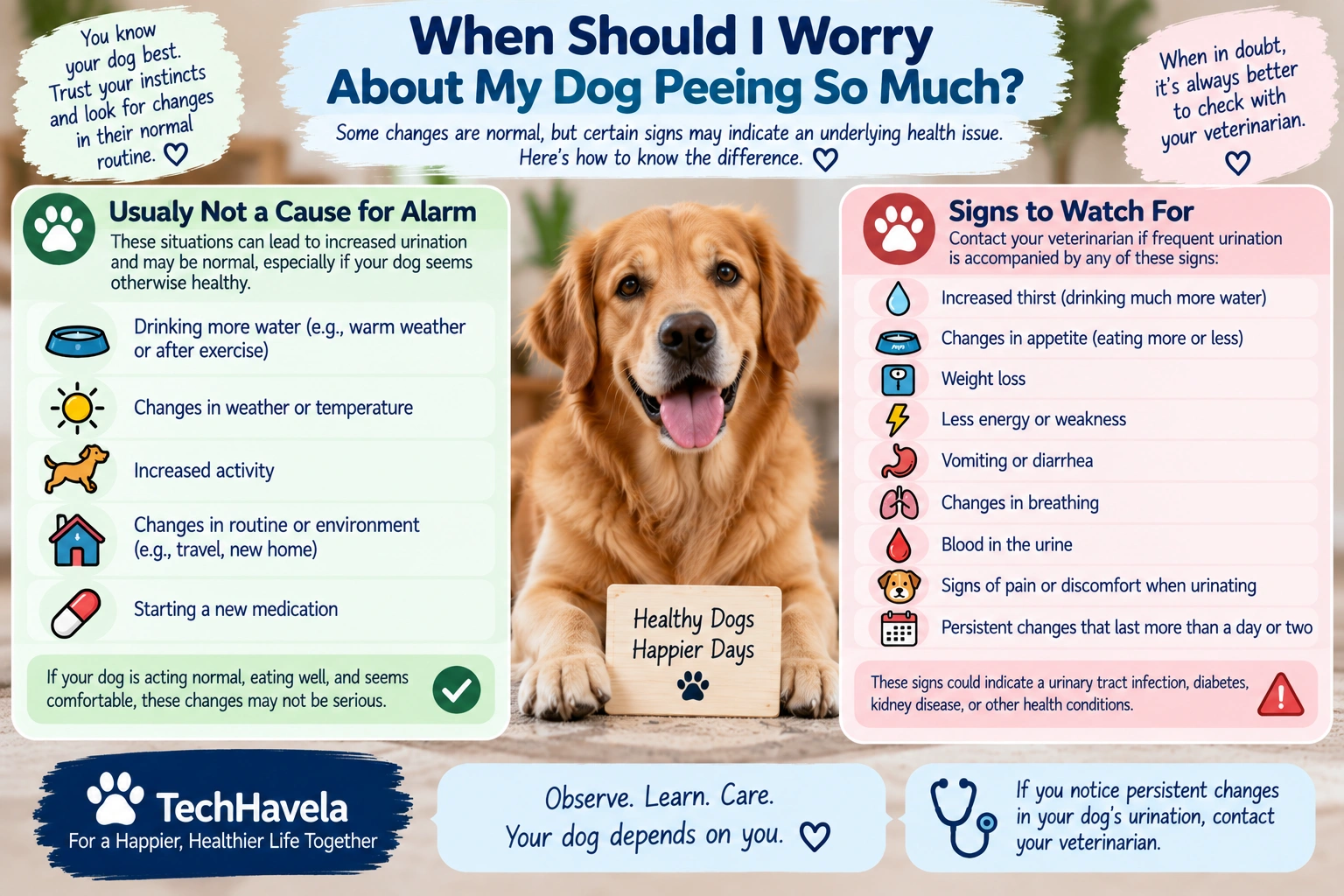
| You May Be Able to Monitor | Contact a Veterinarian |
|---|---|
| Slight increase after drinking more water | Persistent unexplained increase in urination |
| Temporary routine change | Frequent attempts with only small amounts |
| Normal appetite and energy | Pain or discomfort while urinating |
| Normal urine appearance | Urine that looks unusual |
| Drinking pattern remains normal | Significant increase in thirst |
| No unexplained weight change | Unexplained weight loss |
| Pattern returns to normal | New accidents continue or worsen |
Contact your veterinarian sooner if your dog appears ill or uncomfortable.
Repeated attempts to urinate with little or no urine should receive prompt veterinary attention.
What Other Symptoms Should I Watch For?
Frequent urination can provide more useful information when considered together with other symptoms.
Watch for:
Increased thirst: Is your dog drinking significantly more water?
Appetite changes: Is your dog eating more, eating less, or refusing food?
Weight changes: Has your dog lost weight without an obvious explanation?
Weakness or tiredness: Has your dog’s normal energy level changed?
Vomiting or diarrhea: Are digestive symptoms occurring at the same time?
Shaking: Does your dog appear uncomfortable or unusually restless?
Breathing changes: Is your dog breathing faster than usual?
Mobility changes: Is your dog limping or having difficulty moving?
Behavior changes: Is your dog hiding, restless, confused, or acting differently?
A combination of symptoms may provide important clues for your veterinarian.
What Should I Do If My Dog Is Peeing More Than Usual?
First, observe the pattern rather than focusing on a single bathroom trip.
Ask yourself:
- When did the change begin?
- Is my dog drinking more?
- Is the urine amount larger or smaller?
- Is my dog urinating more frequently?
- Does urination appear uncomfortable?
- Have accidents started indoors?
- Has appetite changed?
- Has weight changed?
- Is my dog’s energy level normal?
- Did my dog recently start a medication?
Keep fresh water available unless your veterinarian specifically gives different instructions.
Do not restrict water in an attempt to reduce urination without veterinary guidance.
Do not give human medications or attempt to treat a suspected urinary condition on your own.
If the change persists or other concerning symptoms develop, contact your veterinarian.
Check Your Dog’s Other Symptoms
If frequent urination is happening alongside other changes, looking at those symptoms together may provide a clearer picture.
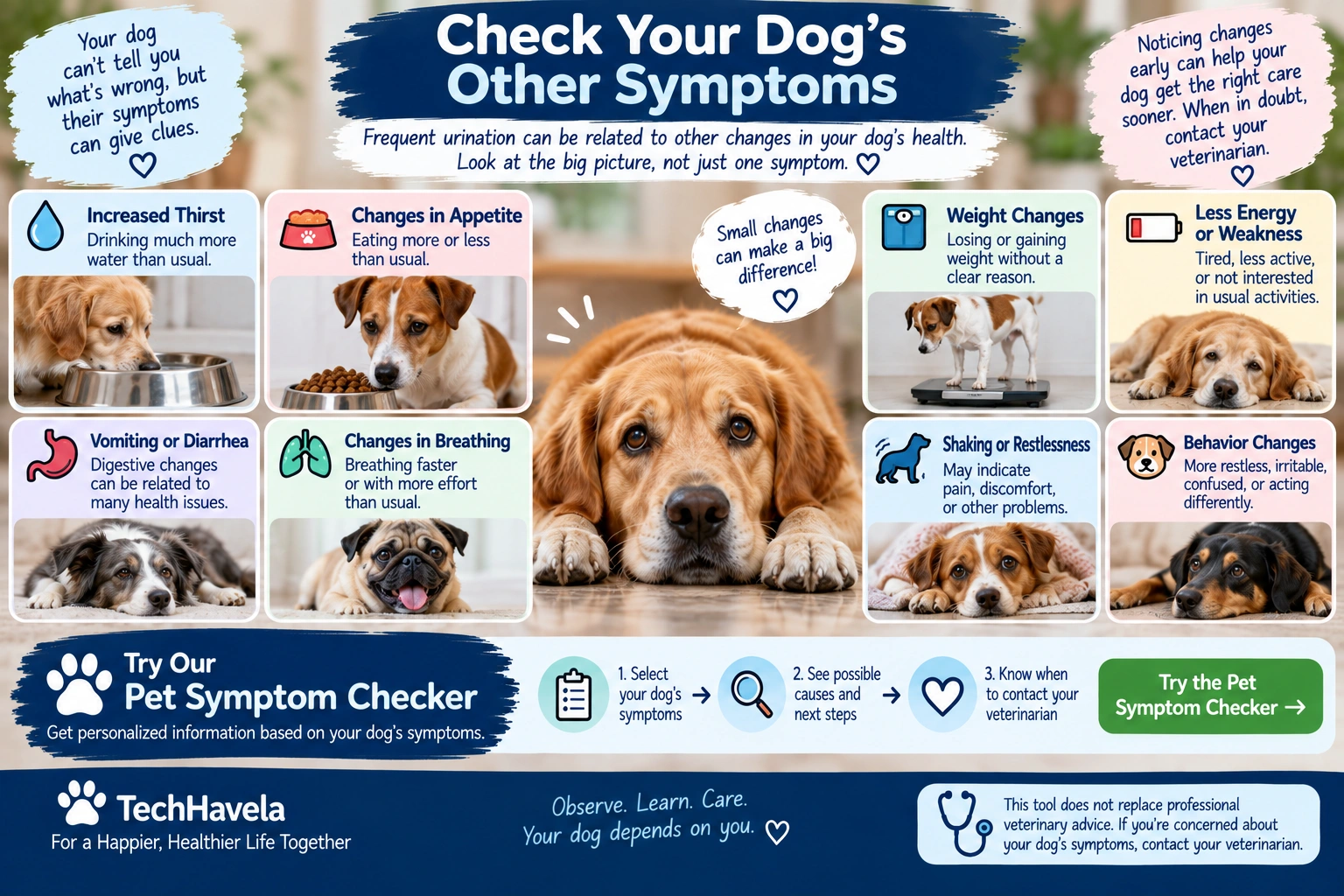
If your dog is drinking much more water, consider whether thirst and urination increased around the same time.
If your dog is not eating, watch for changes in energy, weight, and behavior.
If your dog is vomiting, observe whether drinking and urination patterns have also changed.
If your dog is shaking, consider whether there are other signs of discomfort.
If your dog is breathing fast, notice whether it happens after activity or while resting.
Looking at the overall pattern is more useful than focusing on one symptom in isolation.
Not Sure What Your Dog’s Symptoms Could Mean?
Frequent urination can occur alongside increased thirst, appetite changes, weight loss, digestive problems, weakness, or behavior changes.
The TechHavela Pet Symptom Checker can help you explore common symptoms in dogs and cats, possible causes, warning signs, and situations in which veterinary care may be needed.
The Pet Symptom Checker provides educational information only. It cannot diagnose your pet or replace professional veterinary care.
Frequently Asked Questions
Is it normal for my dog to pee more after drinking more water?
Yes, increased water intake can naturally lead to increased urine production. However, if both thirst and urination remain significantly increased without an obvious explanation, contact your veterinarian.
Why is my dog peeing every hour?
Frequent urination can have several possible causes, including increased water intake, urinary tract irritation, medications, or health conditions. The amount of urine produced and whether your dog appears uncomfortable are important details to observe.
Why does my dog keep trying to pee but only a little comes out?
Frequent attempts with only small amounts may indicate irritation or another urinary tract problem. If your dog repeatedly attempts to urinate but produces very little or no urine, seek prompt veterinary attention.
Can medications make my dog pee more?
Some medications can affect thirst and urination. If you notice a change after your dog begins a medication, discuss it with your veterinarian rather than changing or stopping the medication yourself.
Why is my senior dog suddenly peeing in the house?
Older dogs may experience health, mobility, or bladder-control changes that contribute to indoor accidents. A sudden new pattern in a previously house-trained senior dog should be discussed with a veterinarian.
Should I limit my dog’s water if they are peeing too much?
Do not restrict your dog’s access to water simply to reduce urination unless your veterinarian specifically instructs you to do so. Increased thirst may reflect the body’s need for additional fluid.
When is frequent urination in dogs an emergency?
Repeated attempts to urinate with little or no urine, significant pain or distress, severe weakness, collapse, or other serious symptoms require prompt veterinary attention.
The Bottom Line
If you are asking “Why is my dog peeing so much?”, begin by comparing your dog’s current bathroom habits with their normal routine.
Increased water intake, changes in routine, medications, urinary tract problems, diabetes, kidney conditions, hormonal disorders, and other health issues can all influence urination.
Pay particular attention to whether your dog is urinating more frequently, producing larger amounts, struggling to urinate, drinking more water, losing weight, eating differently, or showing changes in energy or behavior.
Keep fresh water available and avoid attempting to treat urinary problems without veterinary guidance.
If increased urination is persistent, unexplained, uncomfortable, or accompanied by other concerning symptoms, contact your veterinarian.
→ Use the Pet Symptom Checker to explore your dog’s other symptoms and warning signs.

**Sidnir Vieira**
Founder of TechHavela
A passionate pet and tech content creator, helping dog owners across the U.S. make smarter decisions for their furry friends.