Why Is My Dog Losing Hair? Common Causes to Watch
Noticing more dog hair around the house is not always a reason to worry. Dogs naturally shed old or damaged hair, and the amount can change with the season, breed, environment, and coat type.
But what if you can actually see your dog’s coat becoming thinner? What if there are bald patches, irritated skin, excessive scratching, or hair coming out in clumps?
If you’re wondering, “Why is my dog losing hair?”, there are many possible explanations. Some are relatively simple, while others may require veterinary evaluation.
Hair loss in dogs is also known as alopecia. It is not a diagnosis by itself. Instead, it is a sign that something may be affecting the skin, hair follicles, or the dog’s overall health.
In this guide, you’ll learn about common possible causes of dog hair loss, patterns worth watching, and signs that may mean it’s time to contact a veterinarian.
If your dog has other symptoms as well, you can also use our Pet Symptom Checker to explore educational information about common signs in dogs and cats.
Is My Dog Losing Hair or Just Shedding?
The first question is whether your dog is experiencing true hair loss or simply normal shedding.
Dogs naturally replace old hair with new hair. Some breeds shed noticeably throughout the year, while others experience heavier seasonal shedding.
Normal shedding generally does not leave obvious bald areas.
Hair loss may be more concerning when you notice:
- Visible bald or thinning patches
- Hair disappearing from specific areas
- Red or irritated skin
- Frequent scratching, licking, or chewing
- Changes in skin texture or color
- Scaling or crusting
- A noticeable change in coat quality
- Hair loss that continues to spread
According to the Merck Veterinary Manual, shedding without bald patches or symmetrical hair loss may simply represent normal replacement of the coat. Obvious loss of the hair coat, however, deserves closer attention.
1. Allergies Can Cause Hair Loss
Allergies are one possible reason a dog may lose hair.
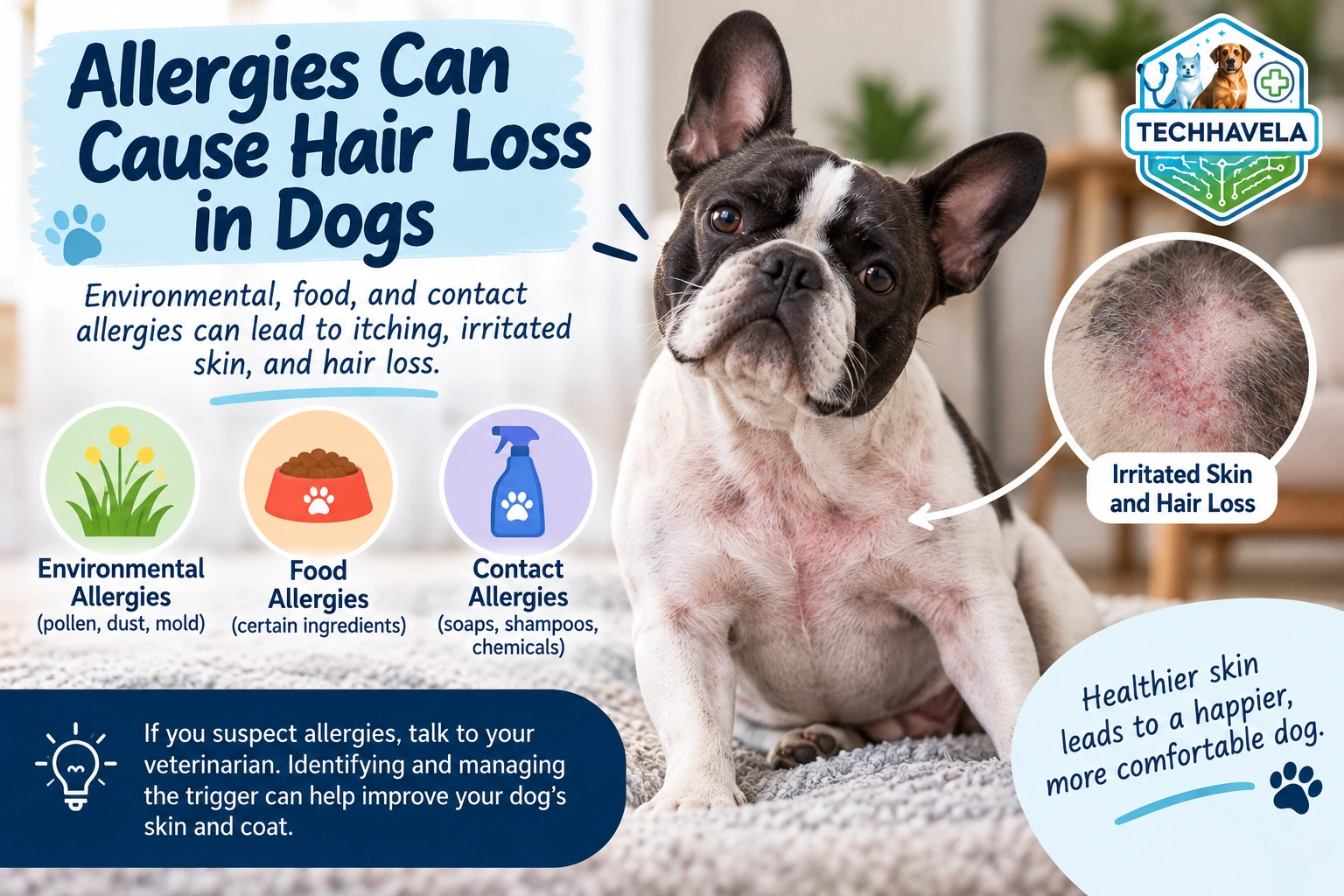
Dogs can react to environmental allergens, flea bites, food-related triggers, or other substances. The resulting itching can lead to repeated scratching, licking, rubbing, or chewing.
Over time, that repeated irritation can damage the coat and cause areas of hair loss.
You may notice hair loss around areas such as the:
- Paws
- Belly
- Face
- Legs
- Ears
- Base of the tail
The skin may also become red, irritated, or darker over time.
If hair loss is accompanied by significant itching, the itching itself is an important clue that a veterinarian may investigate.
We recently covered this symptom in more detail in our guide Why Is My Dog Scratching So Much?
2. Fleas, Mites, and Other Parasites
Parasites are another potential cause of dog hair loss.
Fleas can cause intense itching in sensitive dogs. Repeated scratching and biting at the skin may eventually cause noticeable thinning or bald areas.
Certain mites can also affect a dog’s skin and coat.
You might notice your dog:
- Scratching frequently
- Chewing at certain areas
- Licking excessively
- Developing thinning patches
- Becoming restless because of itching
Hair loss near the lower back or base of the tail can sometimes occur in dogs experiencing flea-related skin irritation, although location alone cannot determine the cause.
A veterinarian can examine the skin and may perform tests when parasites are suspected.
3. Skin Infections
Bacterial and fungal skin conditions can affect hair follicles and contribute to hair loss.
The appearance varies depending on the underlying problem.
In addition to losing fur, a dog may develop changes such as scaling, crusting, irritation, an unusual odor, or changes in skin color.
Because several skin conditions can look similar, appearance alone usually isn’t enough to identify the cause.
Veterinary examination and appropriate testing may be necessary.
Avoid applying human creams, medications, essential oils, or other products to your dog’s skin unless a veterinarian specifically recommends them.
4. Why Is My Dog Losing Hair in Patches?
Patchy hair loss deserves special attention because its pattern may provide useful information to a veterinarian.
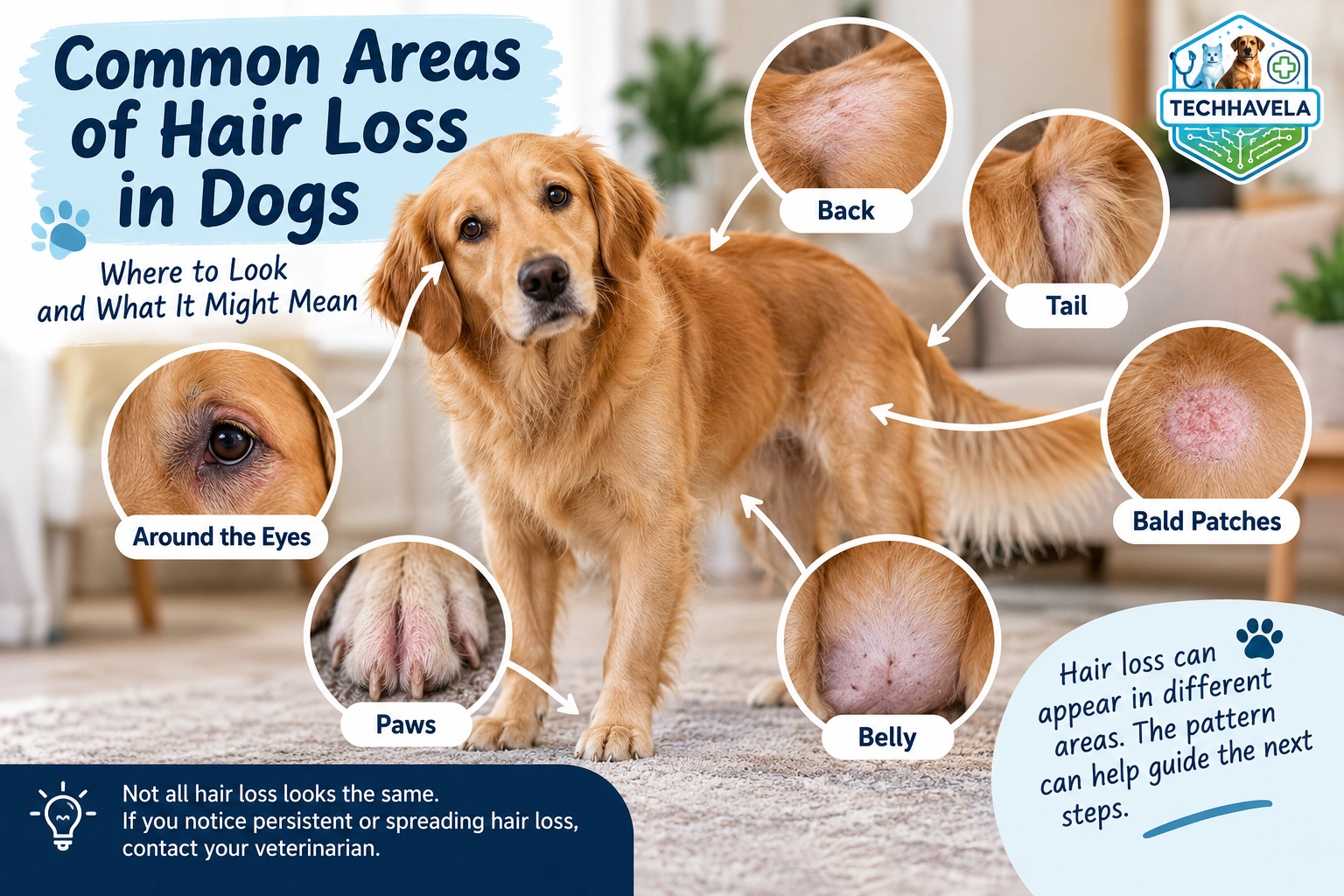
A dog might develop one bald spot or several separate areas of thinning hair.
Possible explanations include skin irritation, parasites, infections, allergies, friction, excessive licking, or other dermatological conditions.
Look at the skin underneath the thinning coat.
Is it normal in appearance, or have you noticed redness, scaling, thickening, or other changes?
Also watch whether your dog is scratching or licking the affected area.
Patchy hair loss is a common pattern in dogs and may appear as a single bald spot or several areas where the coat becomes noticeably thinner. The location and pattern of these areas can provide useful clues when a veterinarian investigates the possible cause.
5. Why Is My Dog Losing Hair and Scratching?
When hair loss and scratching occur together, itching becomes an important part of the picture.
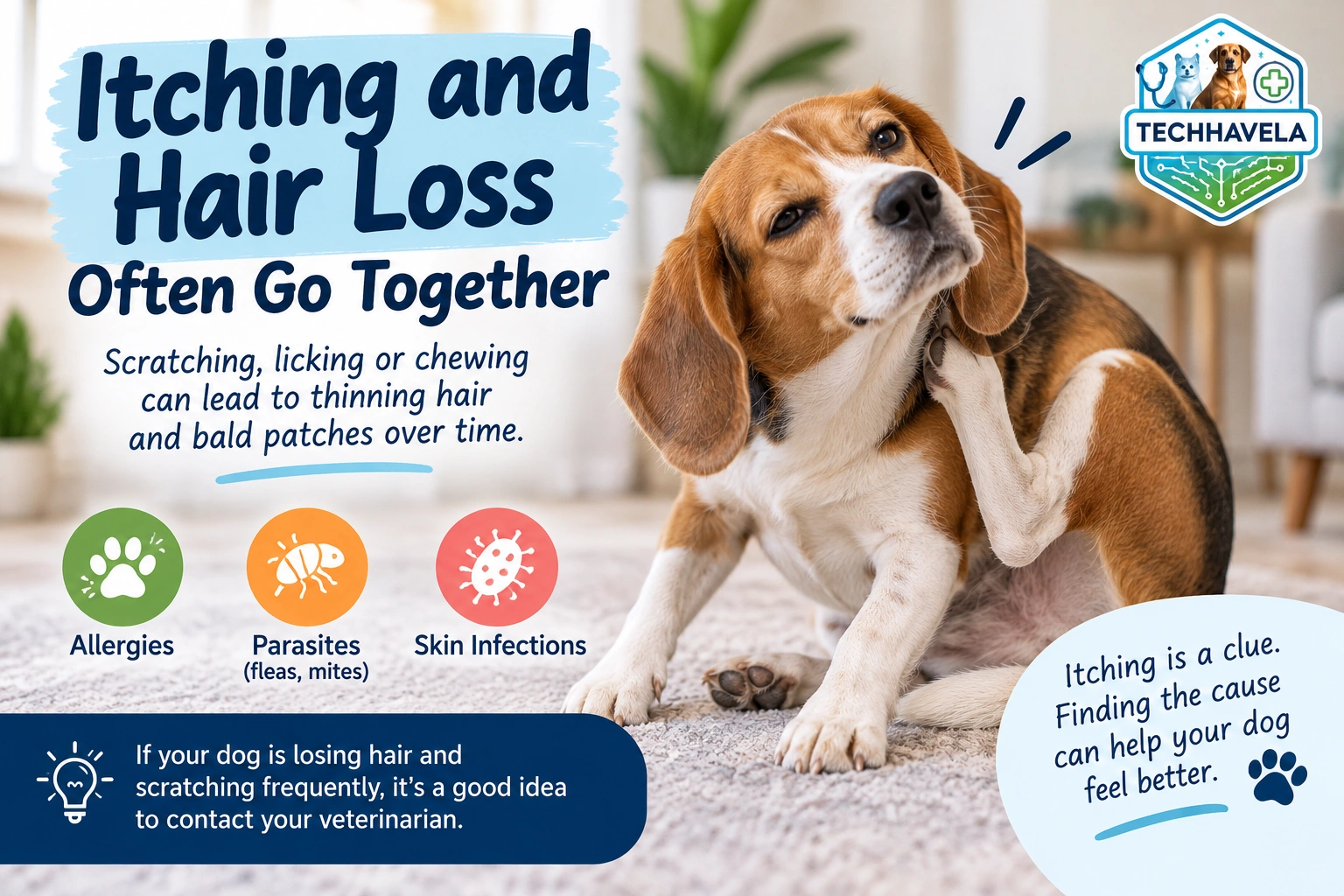
A dog that repeatedly scratches, licks, bites, or rubs the same area can eventually damage the hair and skin.
Potential triggers include allergies, parasites, and infectious skin conditions.
Cornell University notes that dogs with atopic dermatitis can develop hair loss over time as a result of repeated scratching and licking.
This is why it is useful to observe what happened first.
Did the coat begin thinning without noticeable itching?
Or did your dog start scratching before the hair disappeared?
That information can be helpful during a veterinary examination.
6. Hormonal and Internal Health Problems
Not every dog that loses hair has a problem originating in the skin.
Certain hormonal disorders can affect hair growth and coat quality.
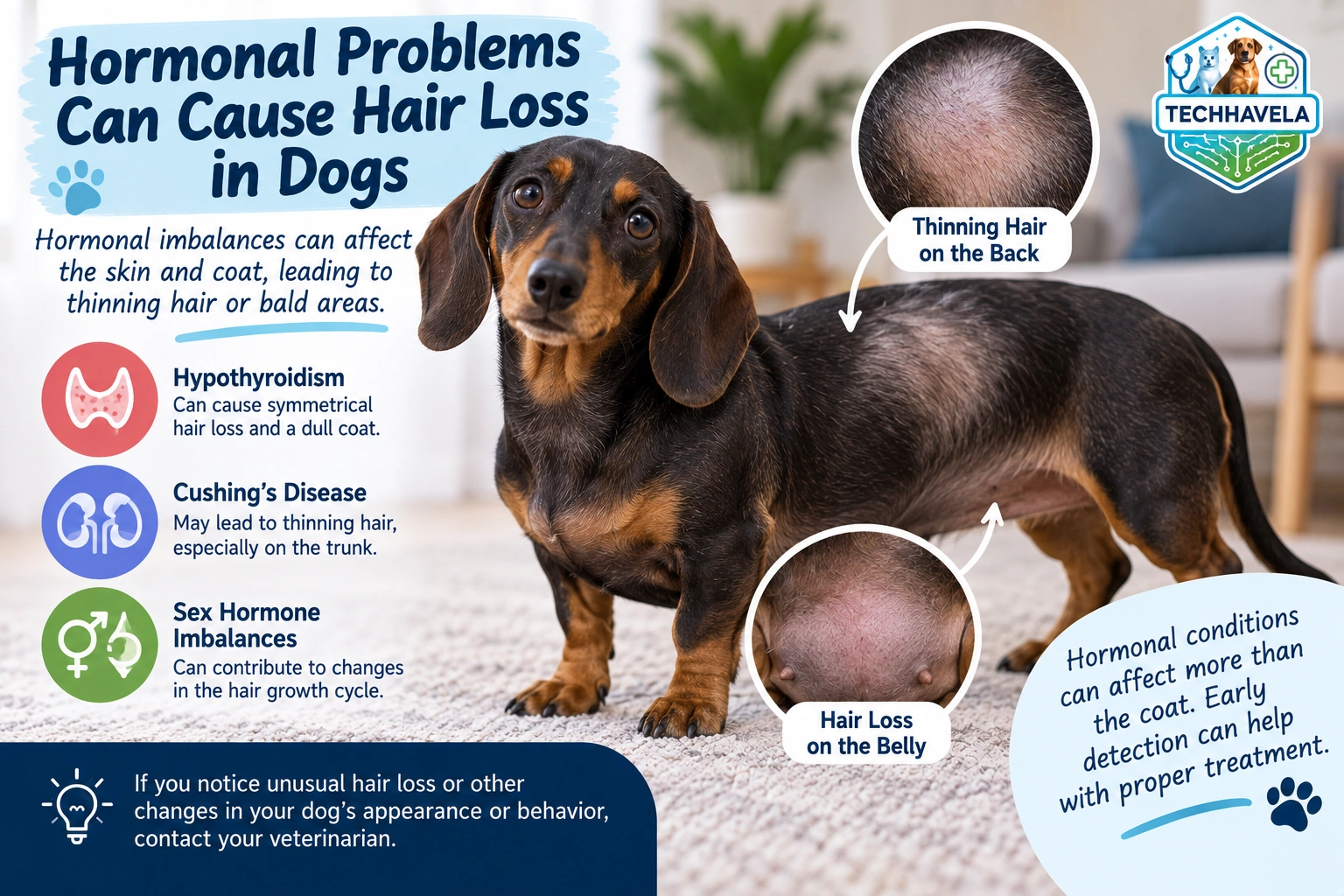
For example, hypothyroidism can be associated with a dry or dull coat, abnormal hair loss, slow hair regrowth, skin changes, and other symptoms. Hair loss associated with hypothyroidism is often not particularly itchy unless another skin problem is also present.
Other endocrine disorders can also affect the coat.
The important point is that hair loss alone cannot tell you whether a hormonal condition is present.
Veterinarians consider the dog’s overall health, physical examination, pattern of hair loss, and other symptoms and may recommend laboratory testing when appropriate.
7. Nutrition and Coat Health
Nutrition plays an important role in healthy skin and hair growth.
A dog’s coat requires adequate protein and other nutrients.
Significant nutritional deficiencies can interfere with normal hair growth, although you should not assume that a thinning coat automatically means your dog needs supplements.
Many other conditions can produce similar changes.
Avoid giving supplements simply because your dog is losing hair unless your veterinarian recommends them. The more useful approach is to review your dog’s complete diet and health history with a veterinary professional when unexplained hair loss continues.
8. Friction and Repeated Licking
Sometimes hair loss is concentrated in an area exposed to repeated friction.
For example, an improperly fitted collar or other repeated physical irritation may contribute to localized hair loss. Merck specifically identifies friction as one possible cause of local hair loss.
Repeated licking can have a similar effect.
If your dog continually licks one spot, however, the next question is why.
Itching, discomfort, or another underlying problem may be encouraging that behavior.
Stopping the licking without understanding the cause may not solve the underlying issue.
9. Why Is My Dog Losing Hair on His Back?
Hair loss along the back can have several possible explanations.
The location by itself is not enough to identify the cause.
Look for additional clues such as itching, skin irritation, flakes, changes in skin color, or hair loss elsewhere on the body.
Also consider whether your dog has recently started wearing different equipment or whether something repeatedly rubs against that area.
The pattern and distribution of hair loss are among the things veterinarians consider during an examination.
10. Why Is My Dog Losing Hair on His Tail?
Hair thinning around the tail is another common concern among dog owners.
Again, there is no single explanation.
Itching and repeated chewing can damage hair around the tail, while some medical conditions can produce other patterns of coat thinning.
Instead of trying to identify the condition from the location alone, look at the whole dog.
Is your dog scratching?
Has thirst or urination changed?
Has body weight changed?
Is the coat thinning elsewhere?
Are there changes in behavior or energy?
Those additional observations can provide much more useful information.
11. Why Is My Dog Losing Hair Around the Eyes?
Hair loss around the eyes can be particularly noticeable because even a small amount of thinning changes a dog’s appearance.
Several skin and health conditions can potentially affect facial hair.
Because the eye area is sensitive, avoid applying creams, oils, shampoos, or medications near the eyes without veterinary guidance.
If the eye itself also appears abnormal or your dog seems uncomfortable, veterinary evaluation is particularly important.
Can Stress Make a Dog Lose Hair?
Stress can affect dogs in several ways, and some dogs may shed more during stressful situations.
However, obvious bald patches or persistent hair loss should not automatically be blamed on stress.
If the coat continues thinning or other symptoms appear, consider other possible causes and discuss the change with your veterinarian.
Can Hair Loss Be Related to a Dog’s Breed?
Sometimes.
Certain inherited or congenital hair disorders are associated with particular breeds and coat characteristics.
For example, Merck describes several hereditary hair and follicle disorders in dogs, including conditions associated with particular coat colors and breeds.
That does not mean breed alone can diagnose the cause.
Breed, age, coat type, the location of the hair loss, itching, and other symptoms are pieces of a larger picture.
What Does the Pattern of Hair Loss Tell You?
The pattern can provide valuable clues.
Hair loss might be:
Focal: concentrated in one area.
Multifocal: appearing in several separate areas.
Symmetrical: occurring similarly on both sides of the body.
Generalized: affecting large areas of the coat.
Merck notes that acquired hair loss can appear in any of these patterns and that veterinarians consider the distribution of hair loss as part of the diagnostic process.
This is one reason photographs can be useful.
Taking a clear photo when you first notice the problem can help you see whether the area is changing over time.
When Should I Be Concerned About My Dog Losing Hair?
Hair loss deserves more attention when it is persistent, spreading, producing obvious bald areas, or accompanied by other changes.
Contact a veterinarian if you are concerned about your dog’s coat, particularly when hair loss occurs alongside significant itching, skin inflammation, unusual skin changes, signs of infection, changes in appetite or energy, or other new symptoms.
Some causes are primarily dermatological, while others may be connected with broader health conditions.
A veterinarian may need to examine both the skin and the dog’s general health.
How Do Veterinarians Investigate Hair Loss?
There is no single test that identifies every possible cause.
A veterinarian may begin by asking about:
- When the hair loss started
- Whether it is getting worse
- Whether your dog is itchy
- Where the hair loss first appeared
- Changes in food or environment
- Parasite prevention
- Other symptoms
- Previous skin problems
The physical examination may include a close inspection of the skin and coat.
Depending on what the veterinarian finds, further investigation can include examination for parasites, skin samples, laboratory testing, or other diagnostic procedures.
Merck notes that accurately identifying the cause requires both a detailed history and physical examination, with additional testing selected according to the suspected underlying problem.
Will My Dog’s Hair Grow Back?
That depends on why the hair was lost and whether the hair follicles remain capable of normal growth.
With some acquired causes, coat growth may improve after the underlying problem is appropriately managed.
Other conditions can affect hair growth differently.
Because there are so many possible causes, it is difficult to predict regrowth without understanding what caused the hair loss in the first place.
What Can I Do at Home?
The most useful thing you can do initially is observe and document the changes.
Notice where the hair loss started, whether it is spreading, whether your dog is scratching or licking, and whether anything else has changed.
Keep your dog’s normal grooming routine gentle.
Do not start human medications, skin creams, essential oils, or supplements in an attempt to treat unexplained hair loss without veterinary guidance.
And don’t assume every case is caused by fleas, allergies, food, or hormones simply because the symptoms look similar to pictures online.
Different conditions can produce remarkably similar skin and coat changes.
Check for Other Symptoms
Hair loss may occur by itself or alongside other signs.
If you’ve noticed additional changes, our Pet Symptom Checker for Dogs and Cats can help you explore educational information about common symptoms and warning signs.
For example, you may also want to read:
Why Is My Dog Scratching So Much? — useful when hair loss occurs with persistent itching.
Why Is My Dog Shaking? — if shaking is another new symptom.
Why Is My Dog Not Eating? — if appetite has changed.
Why Is My Dog Drinking So Much Water? — if increased thirst accompanies other changes.
The symptom checker and our articles are educational resources and are not a substitute for veterinary diagnosis or treatment.
Frequently Asked Questions
Why is my dog losing fur but not scratching?
Hair loss without obvious itching can occur for several reasons. Some hormonal, hereditary, hair-follicle, nutritional, or other health problems may affect coat growth without causing substantial itching. A veterinarian can help distinguish among possible causes.
Why is my dog losing hair in clumps?
Hair coming out in noticeable clumps can have several explanations, including abnormal shedding and skin or follicle problems. Look for bald areas, itching, scaling, or other skin changes and contact your veterinarian if the hair loss is significant or continuing.
Is seasonal shedding normal?
Yes. Dogs naturally shed hair, and seasonal changes can influence the amount. Normal shedding generally should not produce obvious bald patches.
Can allergies cause bald spots in dogs?
Allergic skin disease can cause significant itching. Repeated scratching, chewing, rubbing, and licking may eventually contribute to areas of hair loss.
Why is my dog losing hair in only one spot?
Localized hair loss can have several possible causes, including friction, repeated licking, parasites, infection, or other skin conditions. The appearance of the skin and whether the area is itchy can provide useful clues, but a veterinary examination may be needed to determine the cause.
Should I give my dog supplements for hair loss?
Not automatically. Because hair loss has many possible causes, giving supplements without knowing the underlying problem may not address it. Discuss significant or persistent coat changes with your veterinarian.
Bottom Line
If you’re asking “Why is my dog losing hair?”, remember that hair loss is a symptom rather than a diagnosis.
Sometimes what appears to be excessive hair loss is simply normal shedding. But visible bald patches, persistent thinning, significant itching, skin changes, or other new symptoms deserve closer attention.
Allergies, parasites, skin infections, repeated licking or friction, hormonal disorders, nutritional problems, and hereditary conditions are among the possibilities veterinarians may consider.
Pay attention to where the hair loss occurs, whether your dog is itchy, how quickly it is changing, and whether other symptoms are present.
Those details can help a veterinarian determine what should be investigated next.

**Sidnir Vieira**
Founder of TechHavela
A passionate pet and tech content creator, helping dog owners across the U.S. make smarter decisions for their furry friends.