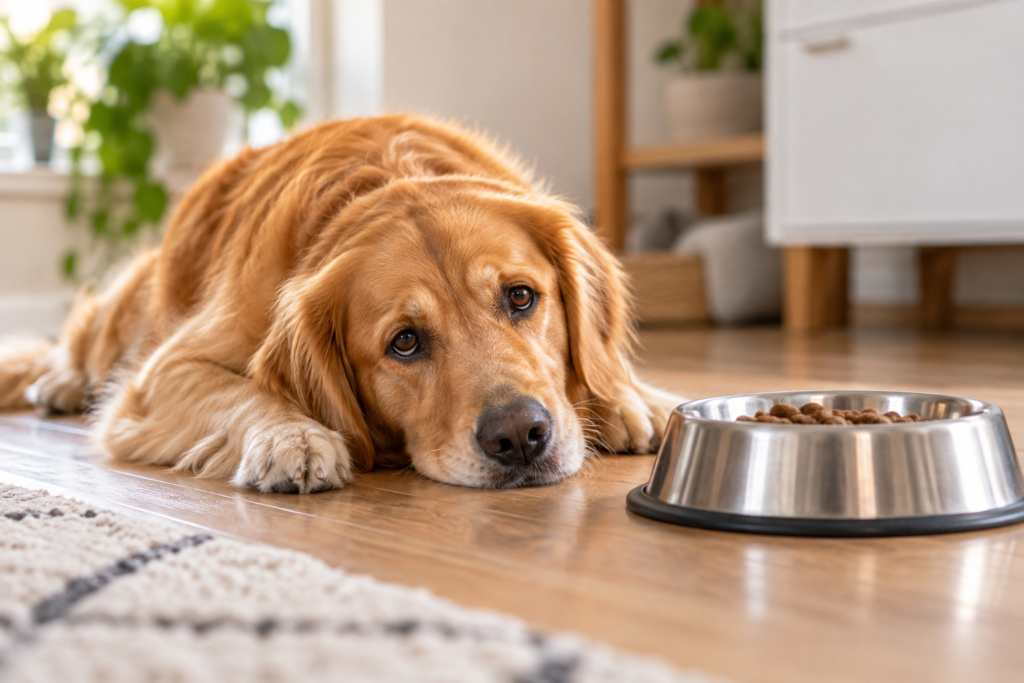
Why Is My Dog’s Eye Red? Common Causes and Warning Signs
If you are wondering why is my dog’s eye red, you are not alone. Redness is one of the most noticeable eye changes dog owners can see, and it may happen for many different reasons.
Sometimes a dog’s eye becomes red because of temporary irritation from dust, pollen, shampoo, or another environmental trigger. In other cases, redness may be associated with conjunctivitis, dry eye, a corneal injury, inflammation inside the eye, or glaucoma.
The important thing is to look beyond the redness itself. Is your dog also squinting? Is the eye watery, swollen, cloudy, or producing discharge? Has your dog’s behavior or appetite changed?
These additional signs can help determine how quickly veterinary attention may be needed.
If your dog is showing several symptoms at the same time, you can also use the TechHavela Pet Symptom Checker to explore other signs you have noticed.
Important: This article provides general educational information and does not replace veterinary care. Sudden, painful, cloudy, injured, or severely red eyes should be evaluated by a veterinarian.
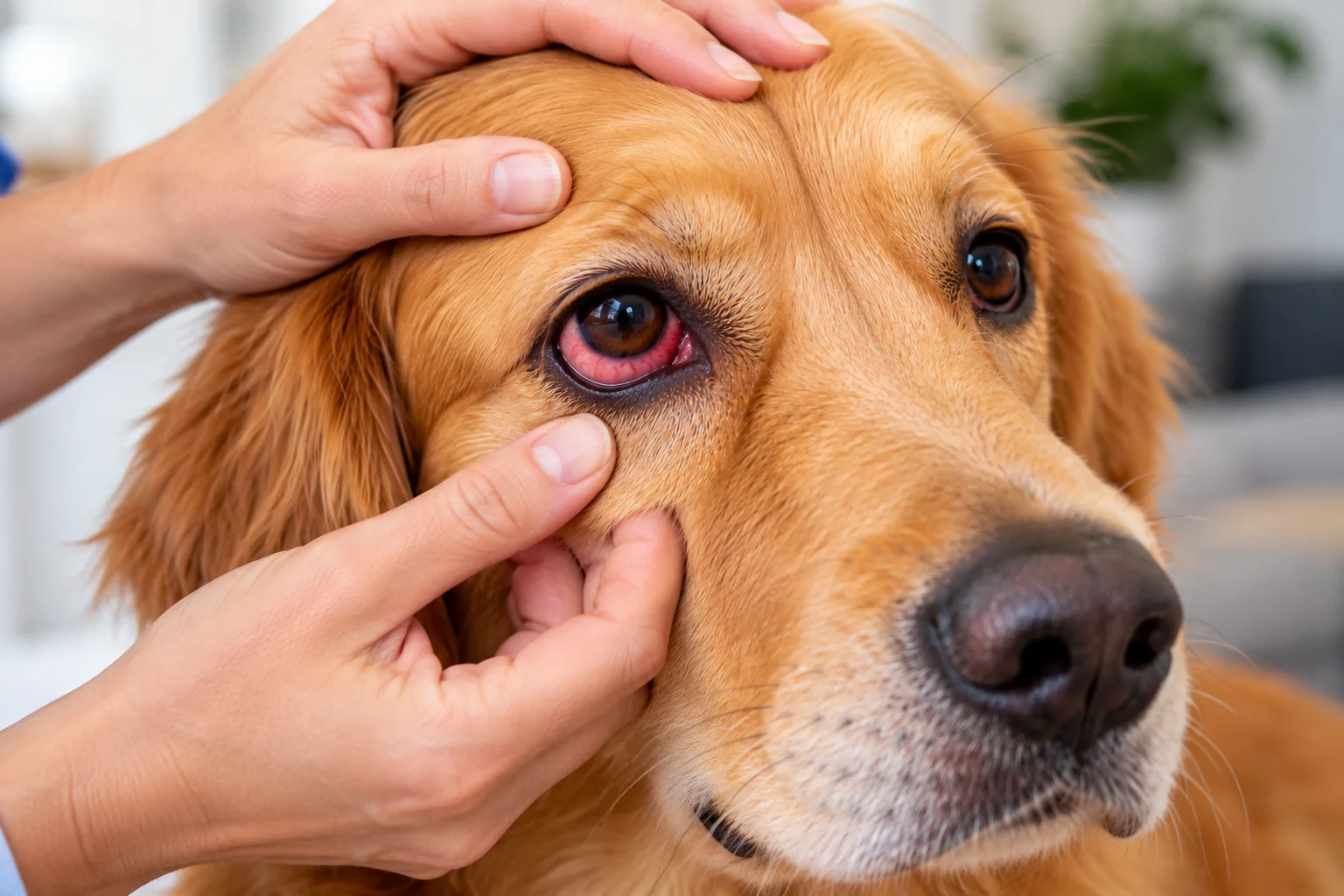
Why Is My Dog’s Eye Red?
A dog’s eye can look red when blood vessels in or around the eye become more visible because of irritation or inflammation.
The redness may involve the conjunctiva, the thin membrane that lines the eyelids and covers part of the eye, or it may be associated with structures deeper inside the eye.
Conjunctivitis is one possible explanation. According to the Merck Veterinary Manual — Disorders of the Conjunctiva in Dogs, conjunctivitis can cause redness, swelling, discharge, and mild discomfort. Merck also explains that appearance alone is usually not enough to determine the underlying cause.
That is why why is my dog’s eye red has no single answer.
The location of the redness, whether one or both eyes are involved, how suddenly it appeared, and other symptoms all matter.
Why Does My Dog’s Eye Look Red? 8 Common Causes
Several conditions can make a dog’s eye look red. Some are relatively minor, while others require prompt veterinary treatment.
1. Conjunctivitis
Conjunctivitis is inflammation of the conjunctiva and is a common reason for red eyes in dogs.
Possible signs include:
- Redness
- Swelling
- Eye discharge
- Increased tearing
- Mild eye discomfort
- More frequent blinking
Conjunctivitis itself is not always the final diagnosis. Infection, environmental irritants, allergens, foreign material, dry eye, and other eye problems can contribute to conjunctival inflammation.
A veterinarian may therefore need to determine why the conjunctiva is inflamed rather than treating redness alone.
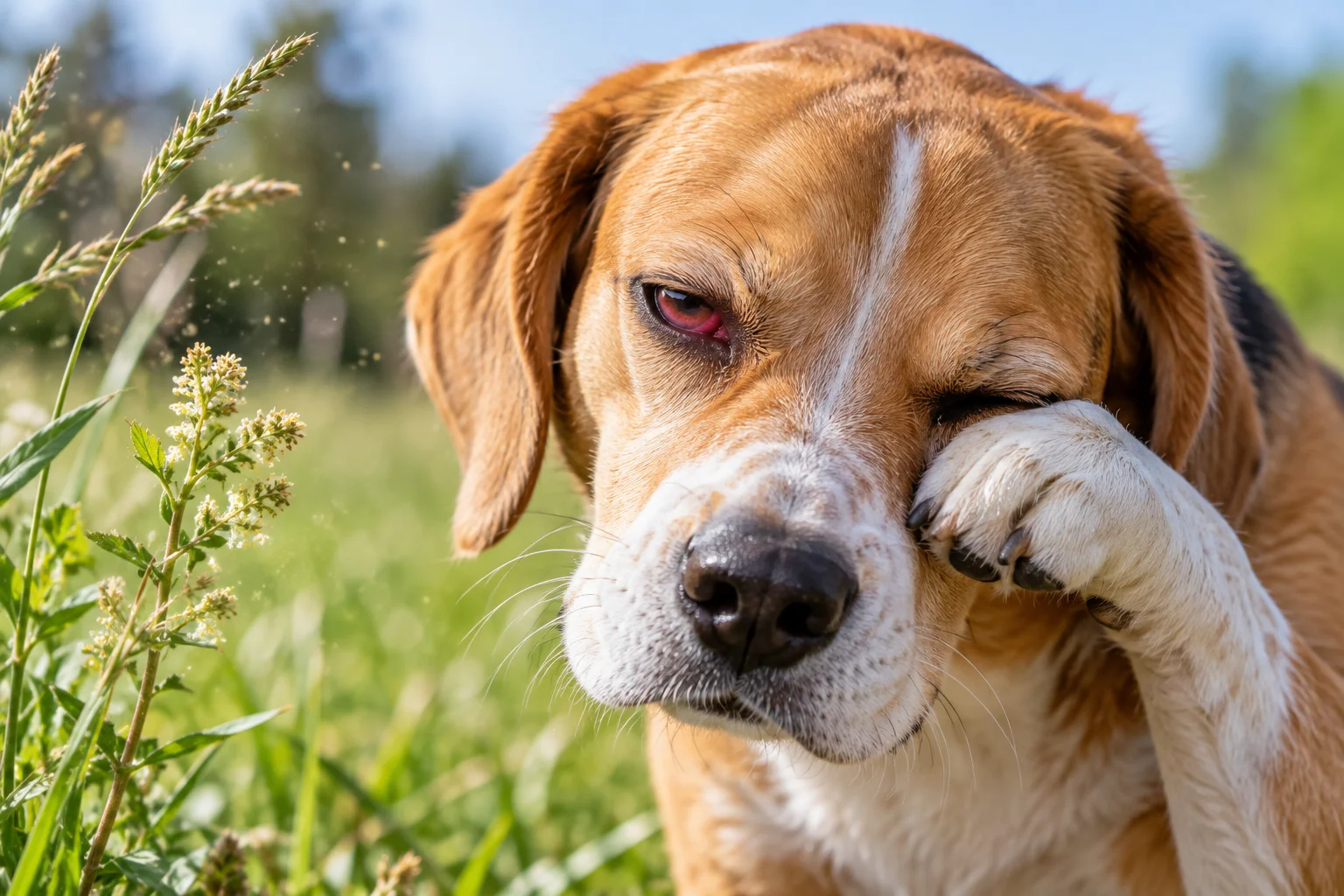
2. Allergies and Environmental Irritation
Dust, pollen, smoke, shampoo, debris, and other environmental substances can irritate a dog’s eyes.
You may notice redness together with increased tearing or blinking.
Think about what your dog was doing before the redness appeared. Playing in tall grass, running through dusty areas, being exposed to smoke, or having a bath could provide useful clues.
However, persistent redness should not automatically be blamed on allergies.
Other eye conditions can initially look very similar.
Why Are My Dog’s Eyes Red and Watery?
The search why are my dog’s eyes red and watery describes another common combination of symptoms.
Watery eyes may occur when irritation causes increased tear production. The eye may essentially be responding to something that is bothering its surface.
But redness and excessive tearing can also occur with painful eye conditions.
Pay attention to whether your dog is:
- Squinting
- Blinking repeatedly
- Rubbing the face
- Keeping one eye partially closed
- Avoiding bright light
- Developing swelling or discharge
Persistent watery redness, especially when accompanied by discomfort, deserves veterinary evaluation.
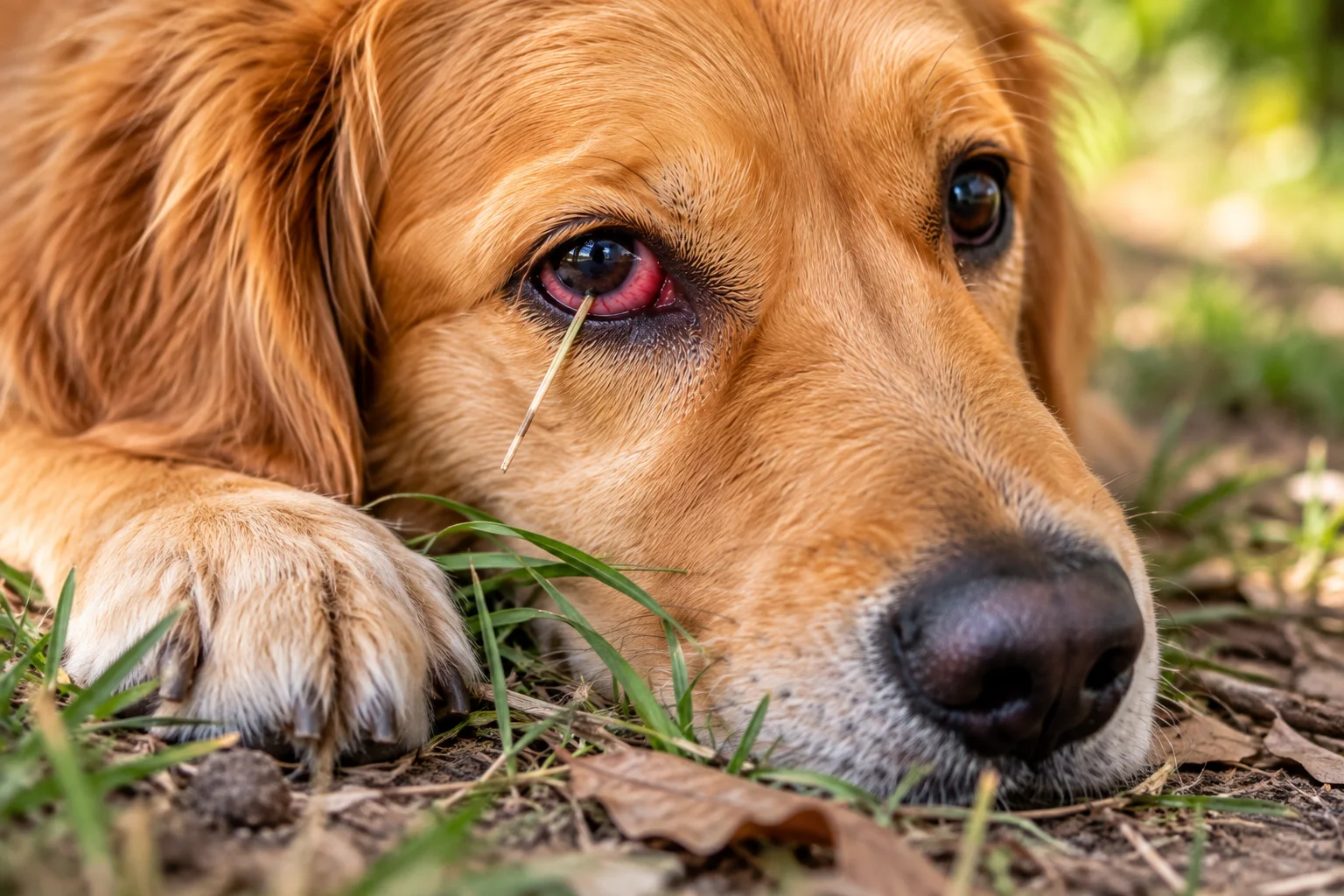
3. Something May Be Irritating the Eye
Dogs spend plenty of time with their faces close to grass, dirt, bushes, carpets, furniture, and other surfaces.
Small particles or foreign material can sometimes irritate an eye.
Possible signs include sudden redness, tearing, squinting, pawing at the face, or keeping one eye partially closed.
Do not try to remove something that appears embedded in the eye. An eye examination can determine whether foreign material is present and whether the cornea has been damaged.
If your dog seems unusually quiet or less active in addition to showing eye symptoms, read What Is Dog Lethargy? Why Is My Dog Lethargic? for other signs worth watching.
4. Corneal Scratch or Ulcer
The cornea is the transparent surface at the front of the eye. Because it is exposed, it can be injured.
A scratch or corneal ulcer may cause:
- Redness
- Squinting
- Rubbing the eye
- Increased tearing
- Discharge
- Sensitivity to light
- A cloudy appearance
The VCA Animal Hospitals guide to corneal ulcers in dogs explains that trauma is a common cause of corneal ulcers and that veterinarians can use fluorescein staining to identify damage to the corneal surface. Vca
A painful eye should not simply be watched for several days in the hope that it improves.
Why Is My Dog’s Eye Bloodshot?
Another useful keyword from our research is why is my dog’s eye bloodshot.
A bloodshot appearance means that blood vessels have become much more noticeable. Irritation and inflammation can cause this appearance, but a significantly bloodshot eye should not automatically be assumed to be minor.
Look for accompanying changes such as:
- Squinting
- Pain
- Cloudiness
- Pupil changes
- Swelling
- Difficulty seeing
- Keeping the eye closed
A suddenly bloodshot and painful eye warrants veterinary attention.
5. Dry Eye
Tears are essential for keeping the eye’s surface moist and protected.
When a dog does not produce enough tears, the condition is commonly called dry eye, or keratoconjunctivitis sicca (KCS).
Insufficient tear production can contribute to irritation and inflammation of the eye’s surface.
A veterinarian can measure tear production as part of an eye examination.
Persistent redness accompanied by thick or unusual discharge is one reason to have the eye checked rather than assuming it is simply an environmental irritation.
6. Uveitis
Uveitis involves inflammation inside the eye.
Because the inflammation is deeper than ordinary surface irritation, it can be difficult for an owner to distinguish uveitis from other causes of a red eye just by looking.
Redness may occur together with pain, squinting, pupil changes, cloudiness, or sensitivity to light.
This is another reason that a persistent or painful red eye should be professionally examined.
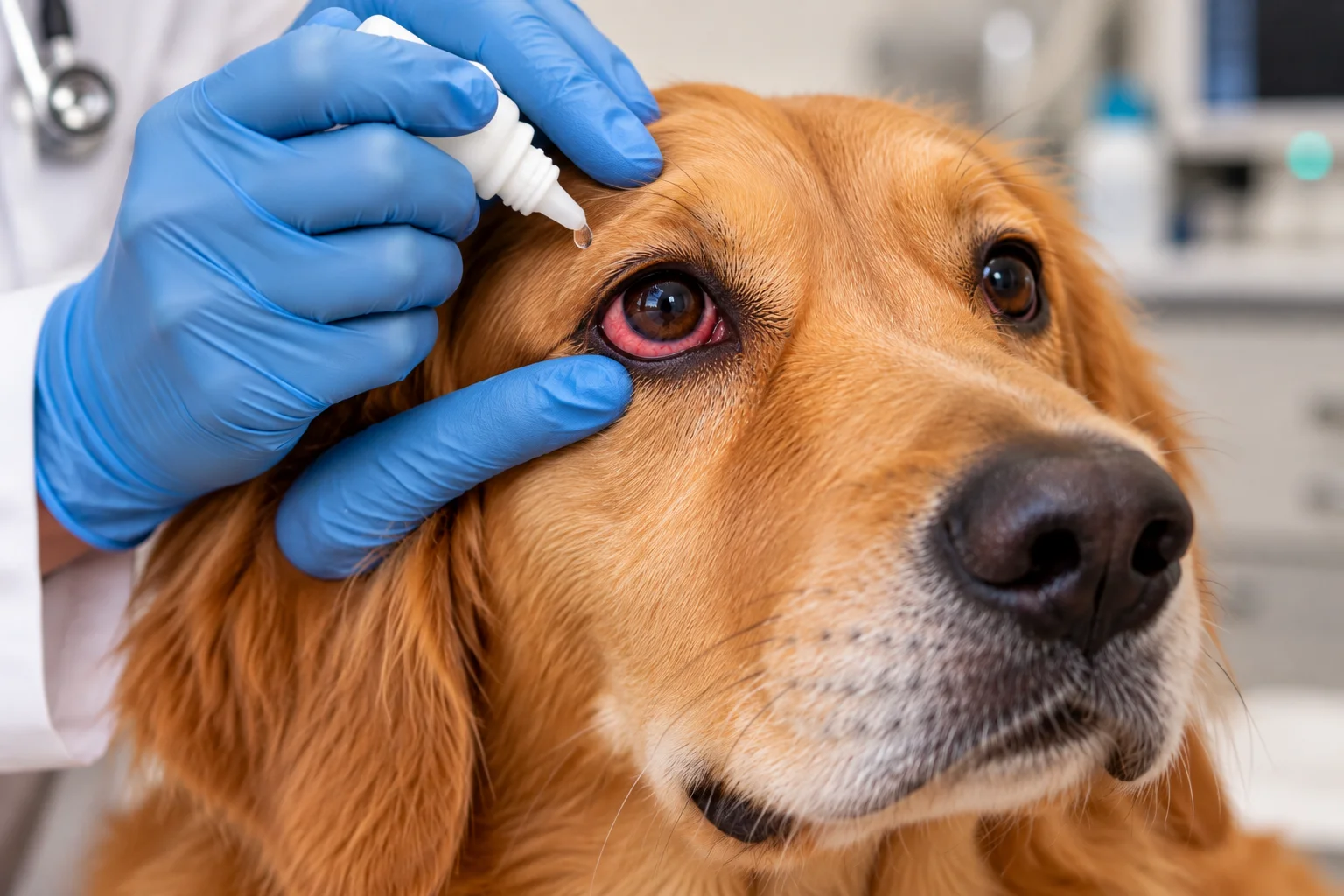
7. Glaucoma
Glaucoma is one of the most important conditions to consider when a dog’s eye suddenly becomes red and painful.
Glaucoma occurs when pressure inside the eye becomes abnormally high.
Cornell University’s College of Veterinary Medicine explains that glaucoma may begin with surprisingly subtle signs — sometimes only a slightly red eye and squinting. Without treatment, the disease can progress and threaten vision.
The Cornell University College of Veterinary Medicine guide to canine glaucoma lists possible signs including:
- Squinting
- Tearing
- Redness
- Corneal haze or cloudiness
- Dilated or slow-moving pupil
- Eye enlargement
- Pain
- Vision loss
- Lethargy
- Reduced appetite
If your dog’s red eye occurs together with unusual tiredness, our article about dog lethargy and its possible causes can help you recognize other behavioral changes.
And if your dog is refusing food while showing other signs of illness, that is another change worth mentioning to your veterinarian.
8. Trauma or Injury
A dog’s eye may become red after a scratch, collision, rough play, contact with vegetation, or another injury.
Eye injuries are not always obvious from the outside.
A dog that suddenly starts squinting, rubbing the face, keeping an eye closed, or avoiding light after an accident should be evaluated.
Eye trauma deserves particular attention because even a small-looking surface injury may involve the cornea.
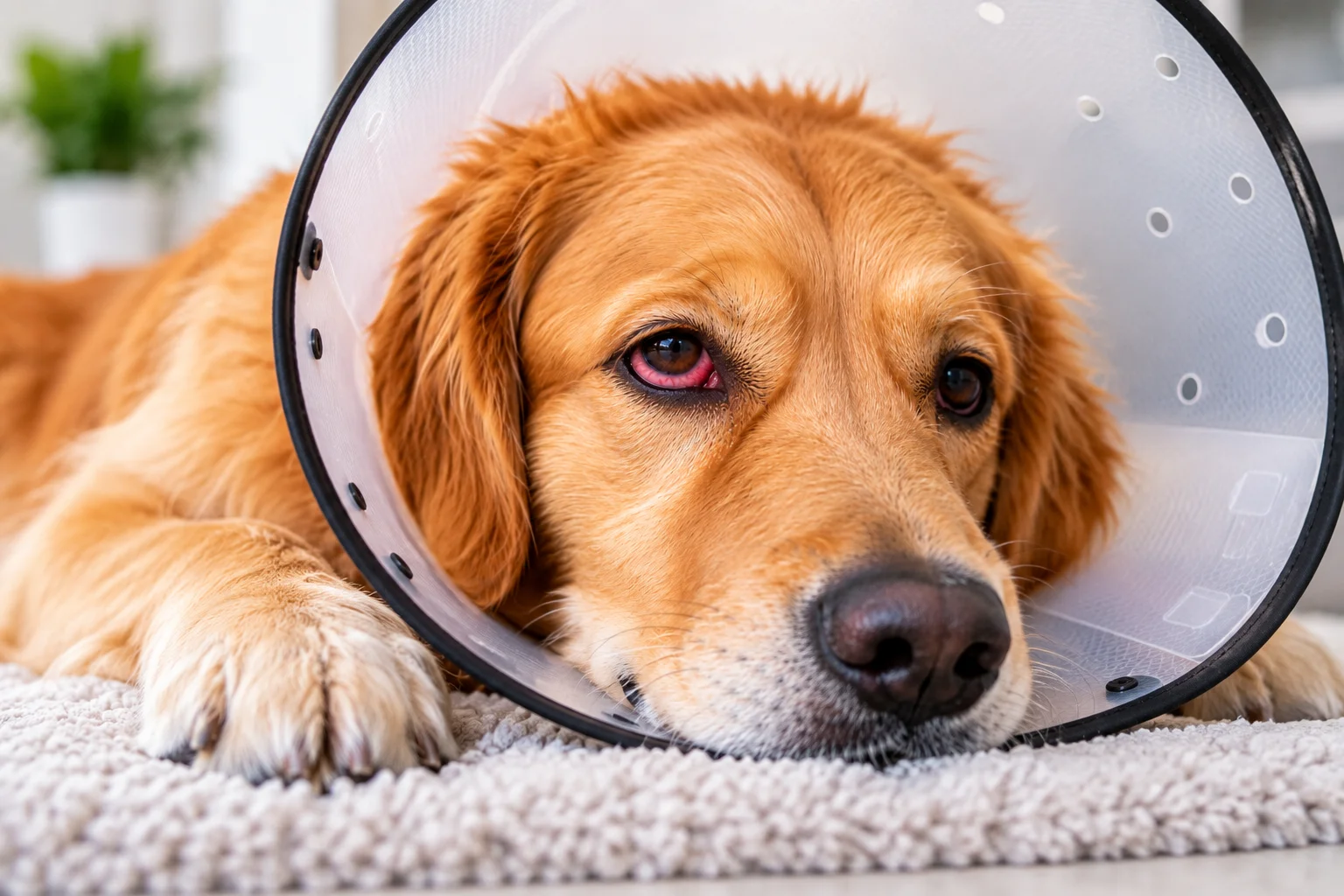
Why Is My Dog’s Eye Red and Swollen?
Why is my dog’s eye red and swollen is another valuable long-tail keyword for this article.
Swelling can accompany inflammation of the conjunctiva and may occur with irritation, trauma, allergic reactions, and other eye problems.
Look for additional signs such as:
- Squinting
- Discharge
- Pawing at the eye
- Difficulty opening the eye
- Cloudiness
- Changes in pupil size
- Apparent vision problems
Rapidly developing or substantial swelling should be evaluated by a veterinarian.
Why Are My Dog’s Eyes Red and Goopy?
Some dogs develop redness together with noticeable eye discharge.
Owners may describe the eye as goopy, sticky, watery, or crusty.
The type of discharge can provide useful information to a veterinarian, but discharge by itself cannot identify the underlying cause.
Conjunctivitis, irritation, dry eye, and other eye disorders can produce discharge.
If the discharge persists, becomes substantial, or appears together with pain, swelling, or difficulty opening the eye, veterinary evaluation is appropriate.
Why Is My Dog’s Eye Red and Has Discharge?
This question is closely related to the previous one and represents another search variation worth addressing.
Redness plus discharge means that something is affecting the eye, but it does not automatically mean that your dog has a bacterial infection.
That distinction matters because different causes require different treatments.
Avoid using leftover eye medications from a previous problem or medication prescribed for another pet.
A veterinarian needs to determine what is causing the current symptoms.
Why Is My Dog’s Eye Red and Cloudy?
A combination of redness and cloudiness deserves particular attention.
Normally, the cornea is transparent.
VCA explains that with a corneal ulcer, fluid can accumulate within the cornea and make it appear cloudy. Vca
Cloudiness can also occur with other eye disorders.
Cornell lists corneal edema — which can appear as a white haze — among signs associated with glaucoma.
Therefore, a red and cloudy dog eye should not automatically be treated as simple irritation or conjunctivitis.
If your dog also appears weak or unusually inactive, consider those symptoms together rather than viewing the eye problem in isolation.
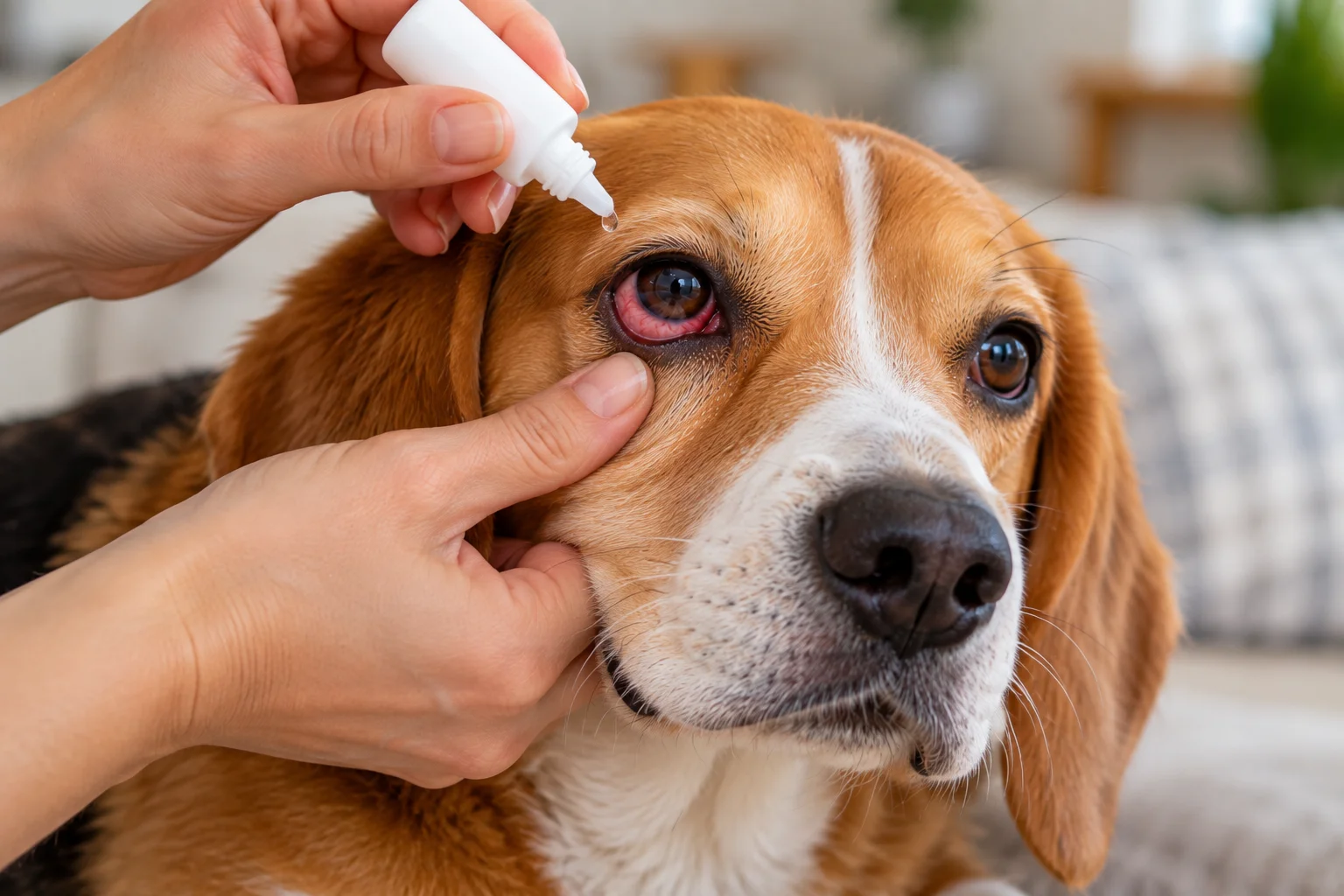
Why Is My Puppy’s Eye Red?
The keyword why is my puppy’s eye red also has useful search demand, so it deserves its own section.
Puppies are curious and active. They may encounter grass, dust, debris, plants, toys, or other objects while exploring their surroundings.
Possible causes of redness include irritation, foreign material, conjunctival inflammation, trauma, or a problem involving the cornea.
Young dogs can also develop a condition commonly called cherry eye.
Cornell explains that cherry eye occurs when the gland of the third eyelid prolapses, creating a smooth pink or red mass near the inner corner of the eye. It is particularly common in younger dogs.
Cornell’s veterinary guide to cherry eye in dogs provides more information about this condition.
If your puppy is squinting, repeatedly rubbing the eye, producing significant discharge, or keeping the eye closed, contact a veterinarian.
Why Is Only One of My Dog’s Eyes Red?
Sometimes only one eye is affected.
A localized problem such as foreign material, irritation, injury, tear-related problems, or corneal damage may affect a single eye.
Merck notes that conjunctivitis affecting only one eye may be associated with a foreign object, tear-sac inflammation, or dry eye.
But one-sided redness does not automatically mean the condition is harmless.
Cornell notes that primary glaucoma usually first becomes apparent in one eye.
Therefore, pay attention to what else is happening.
A red eye accompanied by squinting, cloudiness, pain, pupil changes, or apparent vision problems deserves prompt veterinary evaluation.
Why Is My Dog’s Eye Red in the Corner?
Sometimes the redness seems concentrated at the inner or outer corner of the eye.
One possibility at the inner corner is involvement of the third eyelid.
A visible pink or red mass at the inner corner may resemble cherry eye, particularly in a young dog, but not every red area in the corner of the eye is cherry eye.
Look for:
- Swelling
- Discharge
- Tearing
- Squinting
- Rubbing
- A visible lump
- Changes in the eye’s surface
The location of the redness is useful information to provide to your veterinarian.
Can Eye Problems Change My Dog’s Behavior?
Yes. Pain or reduced vision can sometimes change how a dog behaves.
A dog experiencing discomfort may become quieter, restless, reluctant to play, or less interested in normal activities.
If you notice unusual tiredness, see our TechHavela guide What Is Dog Lethargy?.
A dog having difficulty seeing or feeling disoriented may also hold or move its head differently. If you have noticed persistent abnormal head positioning, our article Why Is My Dog Tilting His Head? explains when a head tilt can be behavioral and when it may deserve medical attention.
The important point is to consider the whole dog, not just the red eye.
When Is a Red Eye in a Dog an Emergency?
Some eye problems are time-sensitive because vision may be at risk.
Seek prompt veterinary care when a red eye occurs with:
- Significant pain
- Persistent squinting
- Inability to open the eye
- Sudden cloudiness
- Apparent vision loss
- A noticeably enlarged or bulging eye
- A very unusual or dilated pupil
- Known eye trauma
- An object embedded in the eye
- Rapidly worsening swelling
- Severe redness with obvious discomfort
Glaucoma deserves special attention because prolonged high pressure inside the eye can damage the optic nerve and lead to blindness. Cornell emphasizes the importance of early diagnosis and treatment.
Do not wait for a red eye to become dramatically abnormal before seeking help when your dog is clearly uncomfortable.
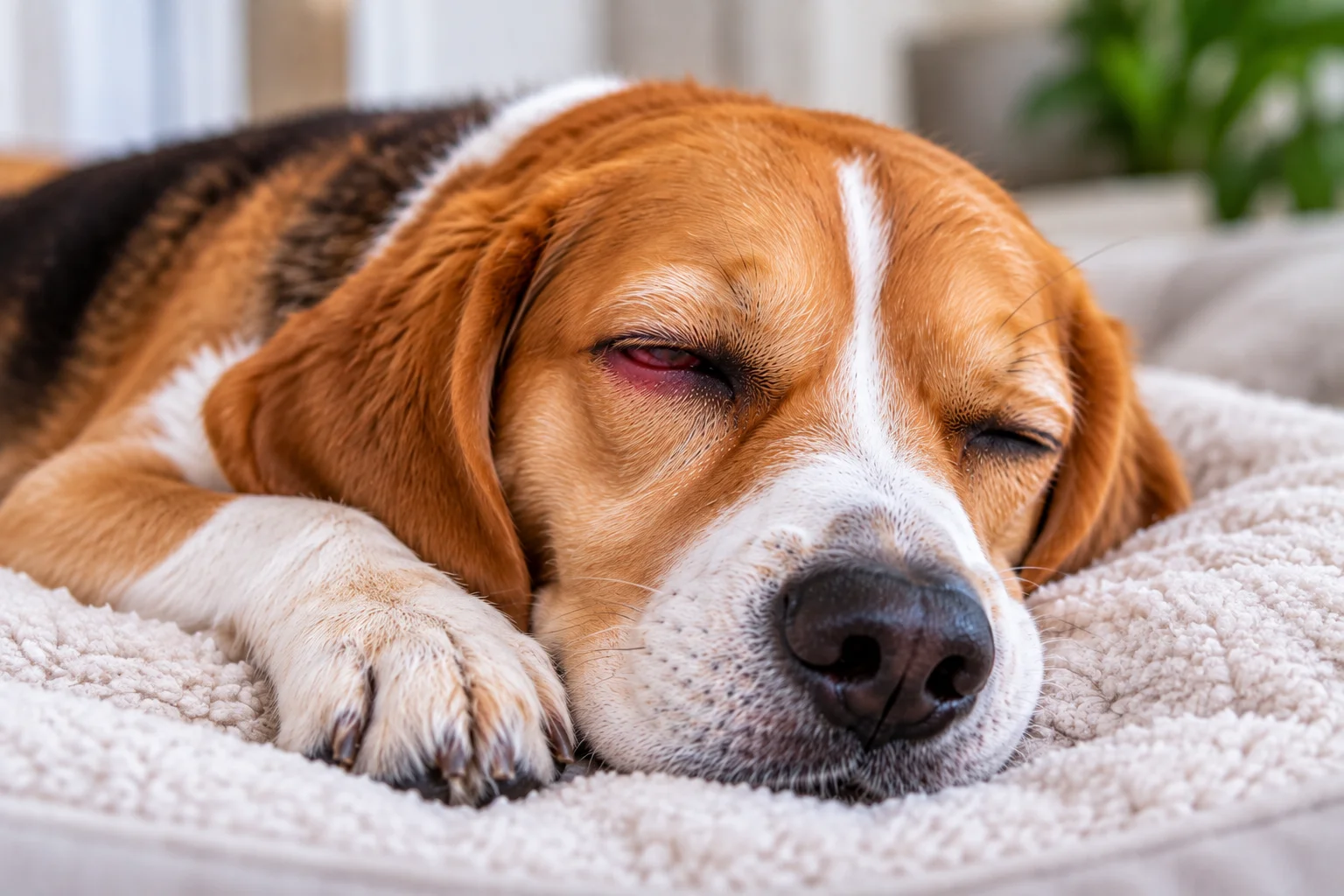
What Should I Do If My Dog’s Eye Is Red?
Start by observing the eye and your dog’s overall condition.
Ask yourself:
Is one eye affected or both?
Did the redness appear suddenly?
Is your dog squinting?
Is there swelling or discharge?
Does the eye look cloudy?
Is your dog rubbing the face?
Has appetite or activity changed?
Does your dog seem to have trouble seeing?
These observations can be useful when speaking with your veterinarian.
Avoid using leftover prescription eye medication or human eye medication unless a veterinarian specifically tells you to use it for your dog.
Different eye conditions can look similar but require very different treatments.
During an examination, a veterinarian may evaluate the eye closely and use diagnostic tests when appropriate. These can include measuring tear production, applying fluorescein stain to identify corneal damage, and measuring pressure inside the eye when glaucoma is suspected.
If your dog has several symptoms and you want to organize what you are seeing before contacting your veterinarian, visit the TechHavela Pet Symptom Checker.
Frequently Asked Questions About Red Eyes in Dogs
Can allergies make my dog’s eyes red?
Yes, allergens and environmental irritants can contribute to eye irritation and conjunctival inflammation. However, persistent redness should not automatically be attributed to allergies because other eye conditions can produce similar signs.
Why is my dog’s eye red and watery?
Irritation and inflammation can cause increased tearing. If the redness and watering persist, or your dog is squinting or uncomfortable, contact your veterinarian.
Why is my dog’s eye bloodshot?
A bloodshot appearance can occur when blood vessels become more noticeable because of irritation or inflammation. Because more serious eye disorders can also cause significant redness, sudden bloodshot redness accompanied by pain, cloudiness, pupil changes, or vision problems should be evaluated.
Why is my dog’s eye red and swollen?
Swelling can accompany conjunctival inflammation, irritation, trauma, allergic reactions, and other eye problems. Rapid or substantial swelling should be examined by a veterinarian.
Why are my dog’s eyes red and goopy?
Redness and discharge can occur with conjunctivitis, irritation, dry eye, and other conditions. The appearance of the discharge alone cannot determine the cause.
Why is my dog’s eye red and cloudy?
Cloudiness may indicate that the normally transparent cornea has been affected. Corneal ulcers and glaucoma are among the conditions that can produce concerning combinations of redness and cloudiness. Prompt veterinary evaluation is advisable.
Why is my puppy’s eye red?
Puppies may develop red eyes because of irritation, foreign material, trauma, conjunctival inflammation, corneal problems, or conditions such as cherry eye. Persistent redness or redness accompanied by pain, discharge, or squinting should be checked by a veterinarian.
Can a red eye in a dog be glaucoma?
Yes. Redness can be an early sign of glaucoma, especially when accompanied by squinting, pain, cloudiness, pupil changes, or vision problems. Cornell notes that glaucoma can begin with only subtle redness and squinting.
Will my dog’s red eye go away on its own?
That depends entirely on the cause.
Temporary irritation may improve, but redness can also indicate a condition requiring treatment. Persistent, painful, cloudy, swollen, injured, or suddenly severe eye changes should be evaluated by a veterinarian.
Final Thoughts
If you have been asking “why is my dog’s eye red?”, remember that redness is a symptom rather than a diagnosis.
Minor irritation is one possibility, but conjunctivitis, corneal injury, dry eye, inflammation, trauma, cherry eye, and glaucoma can also change the appearance of a dog’s eye.
Pay particular attention when redness occurs together with squinting, pain, swelling, discharge, cloudiness, pupil changes, or vision problems.
The combination of symptoms is often more informative than redness alone.
And if your dog is showing other symptoms in addition to a red eye, use the TechHavela Pet Symptom Checker to explore related signs and organize what you may want to discuss with your veterinarian.

**Sidnir Vieira**
Founder of TechHavela
A passionate pet and tech content creator, helping dog owners across the U.S. make smarter decisions for their furry friends.